Charles Taze Russell (1852–1916)
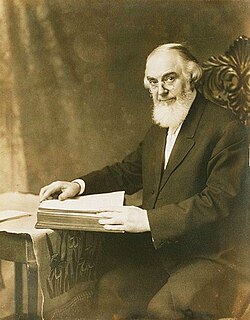 Pastor Charles Taze Russell. Library of Congress.
Charles Taze Russell was a Pittsburgh haberdasher turned religious publisher whose persistent date-setting, tireless organizational energy, and talent for promotion created the movement that would eventually become the Jehovah's Witnesses. Though modern Watchtower literature treats him as a faithful forerunner guided by God's spirit, the historical Russell was a man of deep contradictions: a self-taught theologian with no formal education who claimed no special authority yet allowed followers to call him the "faithful and wise servant" of Matthew 24:45; a man who rejected creeds yet built a publishing empire around his own interpretations; and a prophetic date-setter whose central prediction — that 1914 would see the complete destruction of worldly governments — failed spectacularly, only to be retroactively reinterpreted by his successors.
Early Life and Crisis of Faith
Charles Taze Russell was born on February 16, 1852, in Allegheny, Pennsylvania (now Pittsburgh's North Side), the second of five children born to Scotch-Irish Presbyterian parents Joseph Lytel Russell and Ann Eliza Birney.[1] Only two of the five children survived to adulthood. His mother died in 1861 when Charles was nine years old.[2]
The Russells were devout. Young Charles was known to chalk Bible verses on fence boards and city sidewalks to warn unbelievers about the punishment of hell.[3] His father made him a business partner in his haberdashery store while still in his early teens; by age twelve, Russell was writing business contracts, and by fifteen he was serving as his father's purchasing agent in Philadelphia.[4]
At thirteen, Russell left the Presbyterian Church for the Congregational Church. But by his late teens, he was in full spiritual crisis. The doctrine that troubled him most was eternal torment — he could not reconcile an all-loving God with a literal, burning hell that punished sinners forever.[5] He briefly explored other religions, including Eastern faiths, before drifting toward agnosticism. As he later described it, he "lost confidence in all creeds" and became deeply skeptical of organized religion.[6]
Encounter with Adventism
In 1869, the seventeen-year-old Russell's spiritual trajectory was altered by a chance encounter. Walking near his father's store on Federal Street, he heard singing from a basement meeting hall and stepped inside. There he heard a sermon by Jonas Wendell, an Advent Christian preacher — a remnant of the Millerite Adventist movement that had survived the Great Disappointment of 1844.[7]
Russell later wrote: "Seemingly by accident, one evening I dropped into a dusty, dingy hall, where I had heard religious services were held, to see if the handful who met there had anything more sensible to offer than the creeds of the great churches. There, for the first time, I heard something of the views of Second Adventists, the preacher being Mr. Jonas Wendell."[8]
Though Russell was careful to say that "Adventism helped me to no single truth," he credited the experience with restoring his faith in the Bible's divine inspiration.[9] He subsequently joined an Adventist-oriented Bible study group in Allegheny led by George W. Stetson, pastor of the Advent Christian Church in Edinboro, Pennsylvania. Through this circle he also encountered the writings of George Storrs, publisher of the Bible Examiner, from whom he adopted the doctrines of conditional immortality (the soul is mortal) and the rejection of hellfire — teachings that remain central to Jehovah's Witness theology today.[10]
By about 1870, Russell and his father organized their own independent Bible study group in Allegheny, with Charles elected as "Pastor" — though he had no ministerial training or formal ordination of any kind.[11]
Coping with toxic family dynamics, estrangement, and rebuilding your life. For anyone dealing with the fallout of leaving a high-control group.
View on Amazon →Partnership with Nelson Barbour
The most consequential chapter in Russell's theological formation began in January 1876, when the 23-year-old received a copy of Nelson Barbour's Herald of the Morning magazine in the mail. Barbour, a former Millerite, had been publishing an elaborate chronological framework arguing that Christ had returned invisibly in 1874 and that the "Gentile Times" (calculated as 2,520 years from 606 B.C.) would end in 1914.[12]
Russell telegraphed Barbour and arranged a meeting in Philadelphia. Convinced by Barbour's arguments, Russell sold his five clothing stores for approximately $300,000 (equivalent to several million dollars today) to devote himself full-time to the work.[13] He became assistant editor and financial backer of the Herald of the Morning.
With Russell's funding, Barbour wrote Three Worlds, and the Harvest of This World (1877), a 194-page book laying out their shared prophetic framework — though the book was written entirely by Barbour.[14] It proposed that Christ's invisible presence had begun in 1874, that a forty-year "harvest" period was underway, and that 1914 would see the destruction of worldly governments and the full establishment of God's kingdom on earth.[15]
When the expected rapture of April 1878 failed to materialize, Barbour began questioning core doctrines, including the ransom atonement. Russell could not accept this, and after months of debate through the pages of the Herald, he formally withdrew in May 1879.[16] He took with him many of Barbour's subscribers, associates, and — critically — virtually Barbour's entire chronological framework, including the invisible presence doctrine and the 1914 endpoint.
Zion's Watch Tower and the Birth of a Movement
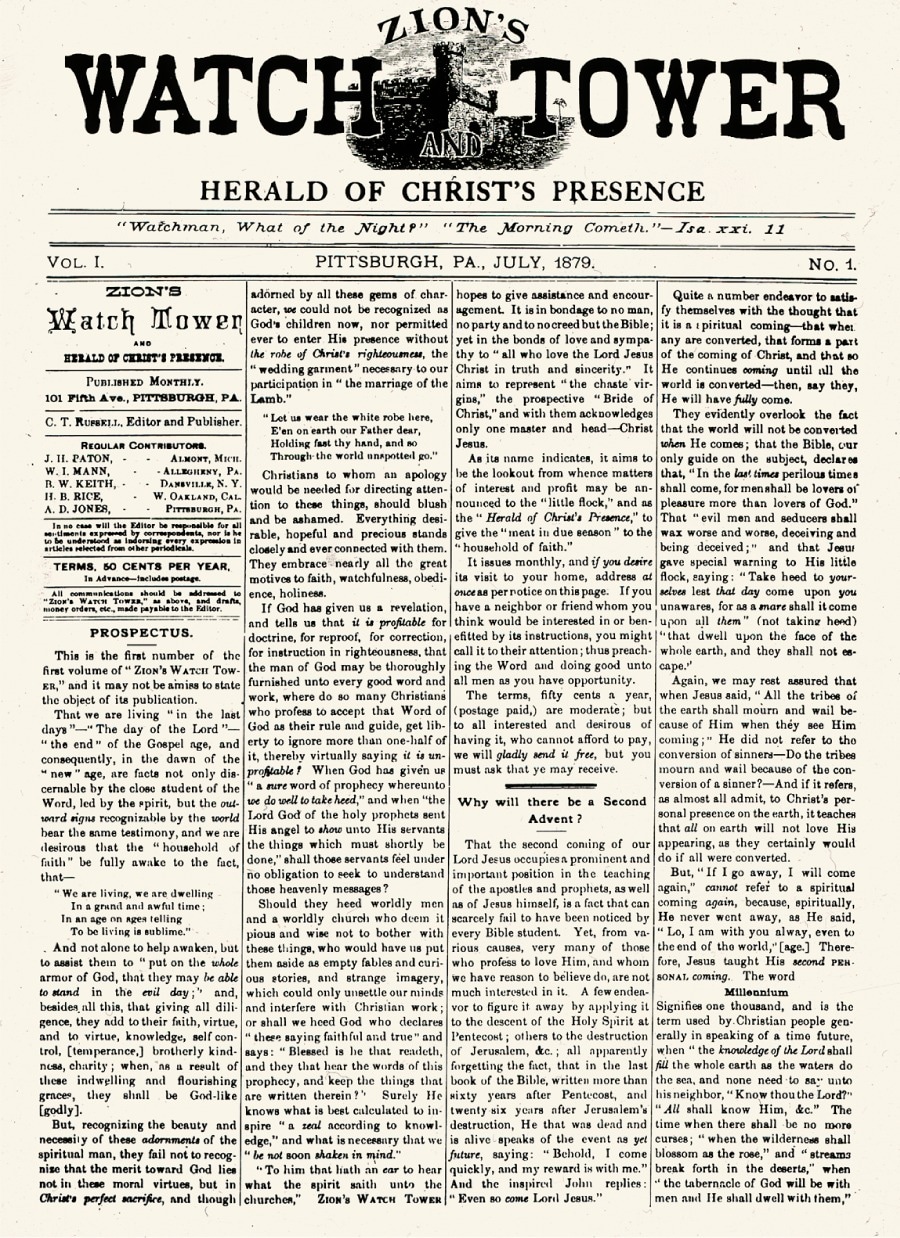 First issue of Zion's Watch Tower, July 1879.
In July 1879, Russell published the first issue of his own journal: Zion's Watch Tower and Herald of Christ's Presence. Six thousand copies were printed.[17] The magazine — which continues today as The Watchtower Announcing Jehovah's Kingdom — became the engine of Russell's growing movement. Semi-monthly publication began in 1892.
On March 13, 1879, Russell married Maria Frances Ackley (1850–1938). Maria became an active contributor to the Watch Tower, writing articles and assisting in the editorial work.[18]
In 1881, Russell co-founded Zion's Watch Tower Tract Society with William Henry Conley as president and Russell as secretary-treasurer. The Society was officially incorporated on December 15, 1884, under Pennsylvania law, with Russell as president.[19] Russell also published Food for Thinking Christians (1881), a 162-page tract with a circulation of nearly 1.5 million copies distributed across the United States, Canada, and Great Britain.[20]
In 1886, Russell began publishing his magnum opus: Millennial Dawn, a multi-volume Bible study series later renamed Studies in the Scriptures. Six volumes were published between 1886 and 1904, with nearly 20 million copies printed and distributed worldwide during his lifetime.[21] By 1909, the Overland Monthly calculated that Russell's writings had become the most widely distributed, privately produced English-language works in the United States — the third most circulated on earth after the Bible and the Chinese Almanac.[22]
In 1908, Russell moved the Watch Tower Society's headquarters from Pittsburgh to Brooklyn, New York, where it remained until 2016.[23]
Key Doctrines
Russell's theological system was not original — nearly every major teaching was borrowed from Adventist predecessors — but he assembled them into a coherent package with extraordinary publishing efficiency:
No hellfire: The wicked are destroyed, not eternally tormented. Inherited from George Storrs and Henry Grew.[10]
No Trinity: God is one person, not three. Jesus is a created being, the first of God's creations. The holy spirit is God's active force, not a person.[24]
Conditional immortality: The human soul is mortal. The dead are unconscious ("soul sleep") until a future resurrection.[25]
Ransom atonement: Christ's death provides a corresponding ransom for Adam's sin, making possible the restoration of all humanity to earthly perfection.[26]
Invisible presence: Christ returned invisibly in 1874 (not 1914 — that reinterpretation came decades after Russell's death). The period from 1874 to 1914 was a forty-year "harvest."[27]
1914 as the end — not the beginning: Russell emphatically taught that 1914 would see the complete destruction of worldly governments and the full establishment of God's kingdom. He wrote in 1889: "We consider it an established truth that the final end of the kingdoms of this world, and the full establishment of the Kingdom of God, will be accomplished at the end of A.D. 1914."[28] This is the opposite of what modern Jehovah's Witnesses teach — that 1914 was the start of the last days.
Restitution: Most of humanity would be resurrected to an earthly paradise and given a second chance at perfection during a thousand-year reign of Christ.[29]
Pyramidology
One of the most embarrassing chapters in Watchtower history — and one the organization has worked hard to suppress — is Russell's enthusiastic embrace of pyramidology. Influenced by the writings of Piazzi Smyth (Astronomer Royal of Scotland), Joseph Seiss, and George Storrs, Russell became convinced that the Great Pyramid of Giza was "God's Stone Witness" — a divinely designed monument whose internal measurements, calculated in "pyramid inches," confirmed his prophetic chronology.[30]
In Thy Kingdom Come (1891), the third volume of Studies in the Scriptures, Russell devoted an entire chapter to the Great Pyramid. He cited Isaiah 19:19–20 as proof that God had placed the pyramid as a "sign and witness" in Egypt, and argued that measuring 2,520 inches along a specific passageway corresponded to the 2,520-year Gentile Times calculation.[31]
When Russell revised his chronology, the pyramid conveniently cooperated. According to an analysis published by earlychurch.net, between the 1897 and 1907 editions of Thy Kingdom Come a key passageway measurement grew by 41 inches — from 3,416 to 3,457 pyramid inches — to accommodate the shift from 1874 to 1914 as the critical date.[32] Stone passageways, of course, do not grow. The most likely explanation is that the reported measurements were adjusted to fit the revised conclusions.
Russell's followers were so convinced of the pyramid's significance that after his death they erected a man-sized pyramid monument adjacent to his grave at Rosemont United Cemetery in Pittsburgh, inscribed with "WATCH TOWER BIBLE AND TRACT SOCIETY."[33] It stands there to this day.
In 1928, twelve years after Russell's death, his successor Joseph Rutherford reversed course entirely, denouncing the Great Pyramid as "Satan's Bible" — built by the Devil to deceive.[34]
The Maria Russell Divorce Scandal
Russell's marriage to Maria Frances Ackley deteriorated through the 1890s. Maria, who had been an active contributor to Watch Tower publications, sought a greater role in editorial management and traveling ministry — requests Russell refused.[35]
The couple separated in November 1897. In June 1903, Maria filed suit for legal separation in the Court of Common Pleas in Pittsburgh, citing mental cruelty — specifically referencing forced celibacy and cold, indifferent treatment.[36]
The most damaging testimony involved Rose Ball, a young woman the Russells had cared for as a foster child since approximately 1888. During the April 1906 trial, Maria's attorney alleged that in 1894 Russell had engaged in "improper intimacy" with Ball, by then approximately 25 years old. Maria testified that Ball had told her Russell described himself as a "jellyfish" who "floated around" from woman to woman until one responded to his advances.[37] The court ultimately struck this testimony on a technicality — the alleged incidents predated the time period covered in Maria's complaint — and Rose Ball left for Australia before the trial, so she was never called to testify.[38]
The separation was granted in 1906, with Russell ordered to pay alimony. A formal decree of "divorce from bed and board" was issued in March 1908. Russell fought the proceedings at every stage, appealing multiple times. He refused to pay the court-ordered increase in alimony and moved operations to Brooklyn. A contempt proceeding was eventually initiated against him.[39]
Maria Russell's own lawyer stated on the record: "We don't mean to charge adultery."[40] But the scandal damaged Russell's reputation, and critics — particularly the Brooklyn Daily Eagle newspaper — used it relentlessly against him.
The "Miracle Wheat" Controversy
In 1911, Russell's Watch Tower magazine advertised a strain of wheat called "Miracle Wheat" for sale at $1.00 per pound — an extraordinary price for the era. The wheat had been developed by a farmer named K. B. Stoner and was claimed to produce five times the yield of ordinary wheat. Proceeds from sales went to the Watch Tower Society.[41]
The Brooklyn Daily Eagle published a cartoon ridiculing Russell and the "Miracle Wheat" scheme, prompting Russell to sue the newspaper for libel, seeking $100,000 in damages. At the January 1913 trial, government agricultural experts testified that the wheat had performed poorly in official tests. The Eagle won the lawsuit.[42]
The Watch Tower Society's secretary-treasurer, William Van Amburgh, testified during the trial that the organization was "not responsible to anyone for our expenditures. We are responsible only to God."[43] The Watchtower later stated that total receipts from the Miracle Wheat sales amounted to "about $1,800" and that "Russell himself did not get a penny."[44]
The Ross Libel Case and the Greek Alphabet
In June 1912, Rev. J. J. Ross of Hamilton, Ontario, published a pamphlet titled Some Facts about the Self-Styled "Pastor" Charles T. Russell, attacking Russell's qualifications, business practices, and character. Russell sued for defamatory libel.[45]
At the March 1913 trial, under cross-examination by Ross's attorney, Russell was asked if he knew the Greek alphabet. He replied "Oh, yes." When shown a page of the Greek New Testament (Westcott & Hort), he was unable to identify the Greek letters, ultimately admitting he did not in fact know Greek.[46] He also initially affirmed under oath that he had been "ordained" but retracted the claim under further questioning. The court returned a verdict of "No Bill," ruling against Russell.[47]
The Photo-Drama of Creation
Not all of Russell's ventures ended badly. In 1914, the Watch Tower Society premiered The Photo-Drama of Creation, an innovative eight-hour multimedia presentation combining synchronized sound, moving film, and hand-painted color slides to trace biblical history from creation to the millennium.[48] At least twenty four-part sets were prepared, allowing showings in eighty cities per day. By the end of 1914, over nine million people in North America, Europe, and Australia had viewed the presentation.[49] It was one of the first major productions to combine film with synchronized audio — a genuinely pioneering achievement.
Death
Russell's health had been declining for several years, aggravated by chronic cystitis. In October 1916, while on a ministerial speaking tour of the western and southwestern United States, he became increasingly ill. His last speaking engagement was in Los Angeles on October 29; his traveling companion, Menta Sturgeon, had to deputize for him during portions of the event.[50]
Attempting to return to Brooklyn by train, Russell died on October 31, 1916, at age 64, near Pampa, Texas.[51] He was buried at Rosemont United Cemetery in Pittsburgh. His weekly sermons had been published by a newspaper syndicate reaching more than 2,000 newspapers with a combined circulation of fifteen million readers. He had served as pastor of more than 1,200 congregations worldwide. He left no personal estate — having devoted his entire fortune to the work.[52]
Legacy: The Man vs. the Myth
The modern Watchtower organization has an awkward relationship with its founder. On one hand, it traces its origins to Russell and celebrates his role as a faithful forerunner. On the other, many of Russell's most distinctive teachings have been abandoned or reversed:
1874 vs. 1914: Russell taught that Christ's invisible presence began in 1874. The Watchtower did not shift this to 1914 until the 1940s — decades after Russell's death.[27]
Pyramidology: Embraced by Russell as "God's Stone Witness," denounced by Rutherford as "Satan's Bible" in 1928.[34]
1914 as the end: Russell predicted the end of worldly governments in 1914. Modern JWs teach 1914 was the start of the last days — the precise opposite of Russell's prediction.[28]
"Faithful and Wise Servant": During Russell's lifetime and for years after his death, the Watch Tower taught that Russell himself was the "faithful and wise servant" of Matthew 24:45.[53] The modern organization applies this title to the Governing Body as a class.
Christian Zionism: Russell was an ardent supporter of Jewish restoration to Palestine — a position the organization eventually abandoned.[54]
Russell's pyramidology, his failed predictions, the divorce scandal, the Miracle Wheat debacle, and his misrepresentations under oath are largely absent from modern Watchtower publications.
Timeline
| Date | Event |
|---|---|
| Feb. 16, 1852 | Born in Allegheny, Pennsylvania[1] |
| 1861 | Mother, Ann Eliza Birney, dies when Charles is nine[2] |
| c. 1865 | Leaves Presbyterianism for Congregationalism; later drifts toward agnosticism[5] |
| 1869 | Hears Jonas Wendell preach; faith in the Bible is restored[7] |
| c. 1870 | Organizes an independent Bible study group in Allegheny[11] |
| Jan. 1876 | Reads Nelson Barbour's Herald of the Morning; contacts Barbour[12] |
| 1876 | Sells five clothing stores (~$300,000) to fund ministry full-time[13] |
| 1877 | Barbour and Russell co-publish Three Worlds, and the Harvest of This World[14] |
| Mar. 1879 | Marries Maria Frances Ackley[18] |
| Jul. 1879 | Publishes first issue of Zion's Watch Tower and Herald of Christ's Presence[17] |
| 1881 | Co-founds Zion's Watch Tower Tract Society; publishes Food for Thinking Christians[19] |
| Dec. 15, 1884 | Watch Tower Bible and Tract Society officially incorporated; Russell elected president[19] |
| 1886–1904 | Publishes six volumes of Millennial Dawn (later Studies in the Scriptures)[21] |
| 1891 | Thy Kingdom Come published with full chapter on Great Pyramid as "God's Stone Witness"[30] |
| Nov. 1897 | Maria Russell separates from Charles[35] |
| Jun. 1903 | Maria files suit for legal separation[36] |
| Apr. 1906 | Separation trial; Rose Ball allegations surface[37] |
| 1907 | Pyramid measurement revised by 41 inches in Thy Kingdom Come to accommodate new chronology[32] |
| Mar. 1908 | Formal divorce decree issued; headquarters moved to Brooklyn, New York[23] |
| 1911–1913 | "Miracle Wheat" controversy; Russell loses libel suit against Brooklyn Daily Eagle[42] |
| Mar. 1913 | Ross libel case in Ontario; Russell caught misrepresenting his knowledge of Greek[46] |
| Jan. 1914 | Photo-Drama of Creation premieres; eventually seen by over 9 million people[48] |
| Oct. 31, 1916 | Dies near Pampa, Texas, at age 64, while returning to Brooklyn by train[51] |
See Also
- Adventist Roots & Precursors — The Adventist lineage Russell inherited
- Early Organizational Structure (1879–1916) — How Russell's movement was structured
- Watchtower Pyramidology — Russell's use of the Great Pyramid in prophetic calculation
- The 607 BCE / 1914 Chronology Problem — The flawed calculation underlying the 1914 doctrine
- Complete Timeline of Watchtower Prophecy Failures — Every failed prediction from 1874 to the present
- Joseph Franklin 'Judge' Rutherford (1869–1942) — Russell's successor who radically transformed the organization
- Bible Student Splinter Groups — Groups that rejected Rutherford's changes and preserved Russell's teachings
References
1. ↩ "Charles Taze Russell," Wikipedia. [en.wikipedia.org]
2. ↩ "Charles Taze Russell," Pennsylvania Center for the Book. [pabook.libraries.psu.edu]
3. ↩ "Charles Taze Russell — Early life," Wikipedia. [en.wikipedia.org]
4. ↩ "Charles Taze Russell," Pennsylvania Center for the Book: Russell joined his father's business at age 11 and was writing contracts by twelve. [pabook.libraries.psu.edu]
5. ↩ LeRoy Edwin Froom, The Conditionalist Faith of Our Fathers, Vol. 2 (1965), pp. 664–665. [egwwritings.org]
6. ↩ "Charles Taze Russell — History," JwCult.com. [jwcult.com]
7. ↩ "Proclaiming the Lord's Return (1870–1914)," Watchtower ONLINE LIBRARY. [wol.jw.org]
8. ↩ Zion's Watch Tower, July 15, 1906, p. 230; reproduced in Jehovah's Witnesses — Proclaimers of God's Kingdom (1993), pp. 43–44. [wol.jw.org]
9. ↩ Zion's Watch Tower, July 15, 1906, p. 230. [wol.jw.org]
10. ↩ "Proclaiming the Lord's Return," Watchtower ONLINE LIBRARY: Storrs' views on mortality of the soul had "a strong, positive influence on young Charles T. Russell." [wol.jw.org]
11. ↩ Froom, Conditionalist Faith, Vol. 2, p. 665: "In 1872 Russell organized an independent 'Bible Class' in Pittsburgh, and in 1876 was elected 'pastor' of the group." [egwwritings.org]
12. ↩ "Nelson H. Barbour," Wikipedia. [en.wikipedia.org]
13. ↩ "Charles Taze Russell," Wikipedia: Russell sold his five clothing stores for approximately $300,000. [en.wikipedia.org]
14. ↩ "Three Worlds (book)," Wikipedia. [en.wikipedia.org]
15. ↩ N. H. Barbour and C. T. Russell, Three Worlds, and the Harvest of This World (Rochester, N.Y., 1877), pp. 83, 143, 189. [archive.org]
16. ↩ "Bible Student movement — Russell–Barbour split," Wikipedia. [en.wikipedia.org]
17. ↩ Zion's Watch Tower and Herald of Christ's Presence, Vol. 1, No. 1, July 1879. See "Bible Student movement," Wikipedia. [en.wikipedia.org]
18. ↩ "Charles Taze Russell — Marriage," Wikipedia. [en.wikipedia.org]
19. ↩ "Charles Taze Russell — Watch Tower Society," Grokipedia. [grokipedia.com]
20. ↩ "Charles Taze Russell," Wikipedia: Food for Thinking Christians had a circulation of nearly 1.5 million copies. [en.wikipedia.org]
21. ↩ "Charles Taze Russell," Wikipedia: nearly 20 million copies of Studies in the Scriptures printed during his lifetime. [en.wikipedia.org]
22. ↩ Overland Monthly (1910); see "Charles Taze Russell," Wikipedia. [en.wikipedia.org]
23. ↩ "Charles Taze Russell," Wikipedia: headquarters moved to Brooklyn in 1908. [en.wikipedia.org]
24. ↩ "Bible Student movement," Wikipedia: Russell outlined nontrinitarian views in 1882. [en.wikipedia.org]
25. ↩ George Storrs, Six Sermons on the Inquiry: Is There Immortality in Sin and Suffering? (1841); influence on Russell documented in Proclaimers (1993), pp. 45–46.
26. ↩ "Bible Student movement — Ransom doctrine," Wikipedia. [en.wikipedia.org]
27. ↩ "1914 — Failed Watchtower Prophecy," JWfacts.com: Russell and Rutherford believed Jesus' invisible presence started in 1874, not 1914. [jwfacts.com]
28. ↩ C. T. Russell, The Time Is at Hand (Studies in the Scriptures, Vol. II, 1889, 1908 ed.), pp. 98–99. [daenglund.com]
29. ↩ C. T. Russell, The Divine Plan of the Ages (Studies in the Scriptures, Vol. I, 1886).
30. ↩ C. T. Russell, Thy Kingdom Come (Studies in the Scriptures, Vol. III, 1891/1903 ed.), pp. 313–314. [daenglund.com]
31. ↩ "Watchtower Pyramidology," daenglund.com. [daenglund.com]
32. ↩ "Russell and The Great Pyramid," earlychurch.net: measurement grew by 41 inches between 1897 and 1907 editions. [earlychurch.net]
33. ↩ "Six Screens of the Watchtower — Pyramidology." [sixscreensofthewatchtower.com]
34. ↩ The Watchtower, November 15, 1928, p. 344: "Satan put his knowledge in dead stone, which may be called Satan's Bible." [daenglund.com]
35. ↩ "Charles Taze Russell — Marriage," Wikipedia. [en.wikipedia.org]
36. ↩ "Charles Taze Russell — Divorce," Wikipedia: Maria filed for legal separation in 1903 on grounds of mental cruelty. [en.wikipedia.org]
37. ↩ "Rose Ball Henninges," users.adam.com.au: trial testimony regarding the "jellyfish" statement. [users.adam.com.au]
38. ↩ Analysis of the Rose Ball allegations, watchtowerlies.com. [watchtowerlies.com]
39. ↩ "Best Charles Taze Russell Divorce Case Page," jwdivorces.bravehost.com. [jwdivorces.bravehost.com]
40. ↩ Court Trial Transcript, Maria F. Russell vs. Charles T. Russell, Court of Common Pleas, Allegheny County, Pennsylvania, 1906. [pastor-russell.com]
41. ↩ Brooklyn Daily Eagle, November 1, 1916; see "Russell and the Miracle Wheat Scandal." [jehovahs-witness.com]
42. ↩ Brooklyn Daily Eagle, January 1913 (multiple articles). [jehovahs-witness.com]
43. ↩ Testimony of W. E. Van Amburgh, Brooklyn Daily Eagle, January 25, 1913. [jehovahs-witness.com]
44. ↩ 1975 Yearbook of Jehovah's Witnesses, p. 69. See "Charles Taze Russell — Miracle Wheat," Wikipedia. [en.wikipedia.org]
45. ↩ "Charles Taze Russell — Ross libel case," Wikipedia. [en.wikipedia.org]
46. ↩ "Charles Taze Russell," Truth of the Gospel Ministry. [truthgospel.org]
47. ↩ "Charles Taze Russell — Ross libel case," Wikipedia: the High Court of Ontario returned a verdict of "No Bill." [en.wikipedia.org]
48. ↩ "Charles Taze Russell — Photo-Drama of Creation," Wikipedia. [en.wikipedia.org]
49. ↩ Jehovah's Witnesses — Proclaimers of God's Kingdom (1993): over 9,000,000 people viewed the Photo-Drama by end of 1914. [wol.jw.org]
50. ↩ "The funeral of Charles Taze Russell," Truth History. [truthhistory.blogspot.com]
51. ↩ "Charles Taze Russell," Wikipedia: died October 31, 1916, near Pampa, Texas. [en.wikipedia.org]
52. ↩ The Watch Tower, December 1, 1916 (memorial issue). [pastorrussell.blogspot.com]
53. ↩ Watch Tower, May 1, 1922, p. 132; see "New Light on Watchtower History," Watchman Fellowship. [watchman.org]
54. ↩ "Charles Taze Russell — Christian Zionism," Wikipedia. [en.wikipedia.org]