Beth Sarim — "House of the Princes"
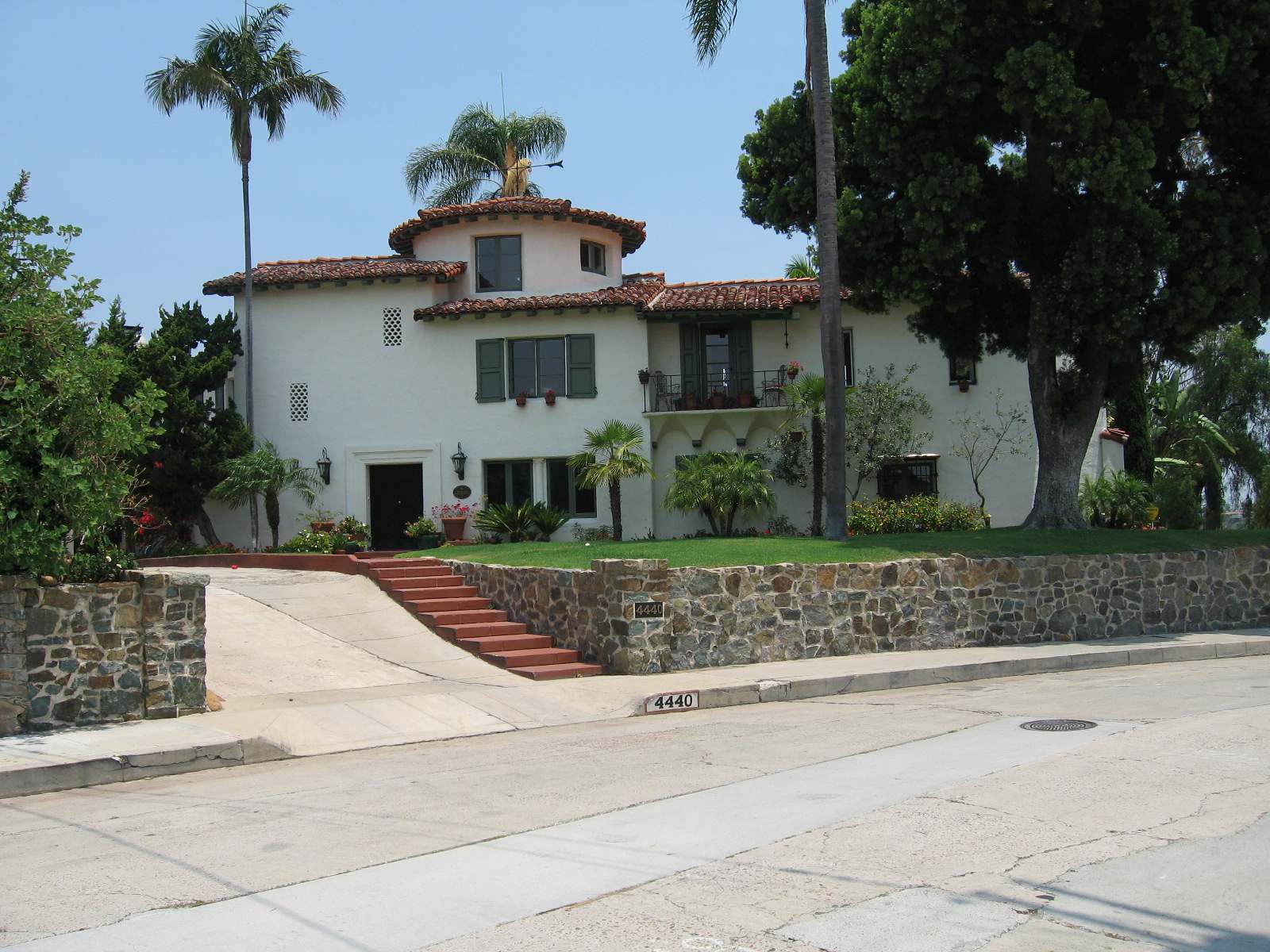 Beth Sarim, San Diego, California. Photo by Bluejay Young, Wikimedia Commons. CC-BY-SA 3.0.
In 1929, at the onset of the Great Depression, the Watch Tower Society constructed a ten-bedroom Spanish Colonial mansion in the Kensington Heights neighborhood of San Diego, California. Its stated purpose: to serve as the earthly residence of resurrected Old Testament patriarchs — Abraham, Isaac, Jacob, Moses, David, and other "faithful men of old" named in Hebrews 11 — who were expected to return to earth at any moment. The property was deeded to these biblical figures by name, held "perpetually in trust," and landscaped with palm and olive trees so the patriarchs would "feel at home." A 16-cylinder Cadillac was parked in the garage for their use. Meanwhile, the actual occupant of the mansion was Joseph Franklin Rutherford, the Watch Tower Society's president, who spent his winters in luxury while many of his followers struggled through the Depression. The patriarchs never arrived. Rutherford died in the house in 1942. The Society quietly sold it in 1948, explaining that it had "fully served its purpose." The story of Beth Sarim illustrates several recurring patterns in the Watchtower organization's history: a bold prophetic claim, a personal arrangement for leadership, a failed prediction, and a subsequent minimization of the episode in institutional memory.
Background: The 1925 Prophecy
Beth Sarim cannot be understood apart from the 1925 prophecy failure. In his 1920 booklet Millions Now Living Will Never Die, Rutherford made one of the most specific predictions in the organization's history:
"Therefore we may confidently expect that 1925 will mark the return of Abraham, Isaac, Jacob and the faithful prophets of old, particularly those named by the Apostle in Hebrews chapter eleven, to the condition of human perfection."
When 1925 came and went without any patriarchal resurrection, the organization hemorrhaged members. But Rutherford did not abandon the prediction — he merely adjusted the timeline. The patriarchs were no longer expected in a specific year but "shortly" or "any day now." Beth Sarim was presented as tangible proof that the organization still expected the patriarchs' return, even after the specific 1925 date had passed without fulfillment.[1]
Construction and Purpose
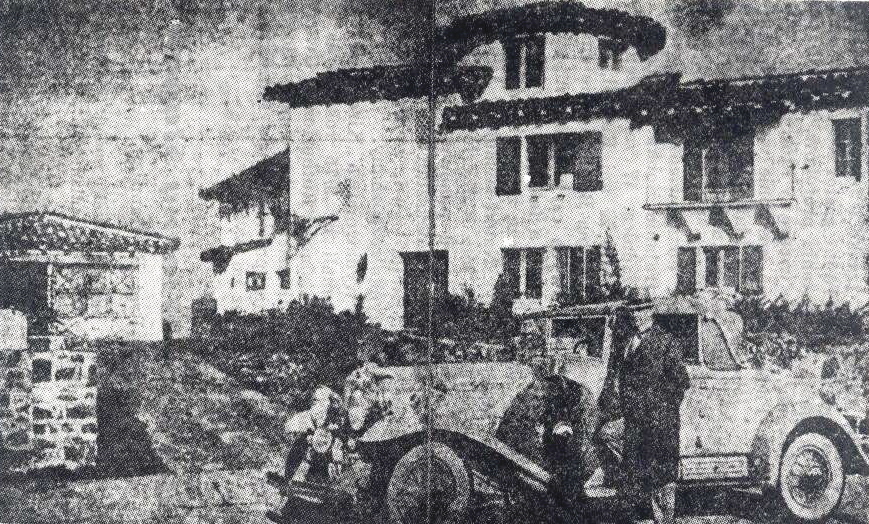 Judge Rutherford with his 16-cylinder Cadillac at Beth Sarim, c.1930s.
The Property
The land was acquired in October 1929 by Robert J. Martin, the factory overseer at Watchtower headquarters in Brooklyn, and transferred to Rutherford in December for a nominal fee of $10. The house was built that same year at 4440 Braeburn Road in the Kensington Heights section of San Diego. It sat on approximately 100 acres of land, landscaped with olive, date, and palm trees — chosen, Rutherford explained, because the climate was similar to Palestine and the trees would be familiar to the resurrected patriarchs.
| Feature | Detail |
|---|---|
| Location | 4440 Braeburn Road, Kensington Heights, San Diego, CA |
| Year built | 1929 |
| Style | Spanish Colonial Revival, ten bedrooms |
| Size | Approximately 5,100 square feet |
| Property | ~100 acres, landscaped with palm, olive, and date trees |
| Name | Beth Sarim (Hebrew: בית שרים — "House of the Princes") |
| Deed held by | Watch Tower Bible & Tract Society, in trust for named Old Testament patriarchs |
| Actual occupant | J. F. Rutherford (1930–1942) |
| Sold | 1948, to private owners |
| Last known sale | 1996, for $450,000 |
The Deed
The deed for Beth Sarim, written by Rutherford himself and published in full in the March 19, 1930 issue of The Golden Age, was unlike any property deed ever filed. It conveyed the property to the Watch Tower Bible & Tract Society "in trust, to be used by the president of the Society and his assistants for the present, and thereafter to be forever at the disposal of the aforementioned princes on the earth."
The Watchtower's own book Salvation (1939) explained the purpose plainly: "The Hebrew words Beth Sarim mean 'House of the Princes'; and the purpose of acquiring that property and building the house was that there might be some tangible proof that there are those on earth today who fully believe God and Christ Jesus and in His kingdom, and who believe that the faithful men of old will soon be resurrected by the Lord, be back on earth, and take charge of the visible affairs of earth."[3]
A Luxurious Waiting Room
While the stated purpose was to house resurrected patriarchs, the actual function was to serve as Rutherford's personal winter residence and executive office. Rutherford's health was cited as the justification: a severe case of pneumonia after his release from prison in 1919 had left him with diminished lung capacity, and his doctor urged him to spend winters in San Diego's mild climate.
The accommodations were far from modest. Newspapers of the era reported on Rutherford's lifestyle at Beth Sarim, which included a 16-cylinder Fisher Fleetwood Cadillac coupe — reportedly stocked in the garage for the patriarchs' use but driven by Rutherford — and the spacious ten-bedroom mansion itself. The San Diego Sun provided colorful coverage, noting the toiletries set out for the patriarchs and imagining "what a thrill giant-shouldered Samson, who wrecked a palace with his bare fists, might find in the gold safety razor and strop!"
The contrast with the circumstances of ordinary Witnesses was stark. This was the Great Depression. Many of Rutherford's followers were struggling to feed their families, working part-time or not at all, and devoting their remaining resources to the door-to-door preaching work. Their leader spent winters in a ten-bedroom mansion with two luxury automobiles. Former Watchtower legal counsel Olin R. Moyle, in his famous 1939 letter to Rutherford, cited Beth Sarim as one example of "the difference between the accommodations furnished to you, and your personal attendants, compared with those furnished to some of your brethren." Walter F. Salter, former manager of the Canadian branch, similarly criticized Rutherford's use of the property. A reply to Salter's criticisms was published in the May 2, 1937 Golden Age, with a photocopy of a letter from W. E. Van Amburgh, the Society's secretary-treasurer, asserting that "not one cent of the funds of the Watch Tower Bible and Tract Society went into the construction of the home" — claiming it was built entirely with directed personal contributions. Rutherford's lifestyle extended beyond Beth Sarim. He summered in Europe and reportedly owned two Cadillacs. At Brooklyn headquarters, Bethel workers lived in austere communal conditions on minimal allowances while their president enjoyed accommodations that would have been enviable even outside the organization. [4]
The Man Who Came to the Door
In one of the more darkly comic episodes in Watchtower history, a man actually did show up at Beth Sarim claiming to be King David. According to The San Diego Sun, Rutherford reported: "One morning as I was going from the house to the garage, a queer looking creature approached me, tipped his dirty hat and cried 'Howdy Judge, I'm David.' 'Go and tell that to the winds,' I told him and he left without arguing the matter." The irony of a man being turned away from a house ostensibly built for resurrected patriarchs was noted by observers at the time.[5]

Coping with toxic family dynamics, estrangement, and rebuilding your life. For anyone dealing with the fallout of leaving a high-control group.
View on Amazon →Beth Shan: The Secret Second Property
Less well known than Beth Sarim is Beth Shan (Hebrew: "House of Security"), an adjacent property acquired by the Watch Tower Society in 1938–1939. Beth Shan encompassed roughly 75 acres of canyon land near Beth Sarim. A house was built on the property, and improvements were made beginning in 1939.
The deed for Beth Shan was even more explicit than Beth Sarim's. It named specific biblical figures as beneficiaries: "Abel, Enoch, Noah, Abraham, Isaac, Jacob, Sara, Joseph, Moses, Rahab, Gideon, Barak, Sampson, Jephthae, David, Samuel." The stated purpose was identical — to house the resurrected patriarchs.
Beth Shan also served a more personal purpose. Rutherford wanted to be buried there. When he died on January 8, 1942, at Beth Sarim — surrounded by a small circle of attendants including his nurse, Bonnie Boyd Heath — requests were made to San Diego County officials for permission to bury him on the property. The first request — for burial below Beth Sarim itself — was denied. A second request for a 10-by-10-foot plot at Beth Shan was also denied, reportedly for health reasons regarding the disposal of bodies. A cement crypt had reportedly been constructed at the property during Rutherford's final days in anticipation of his death. The Consolation magazine of May 27, 1942 condemned local officials for the refusal, arguing that it was "fitting and appropriate before God and before men that his bones should rest on the land held in trust for the men whose coming he was privileged to announce." Denied permission for a California burial, Rutherford was ultimately interred at Woodrow Memorial Park (now Rossville Cemetery) on Staten Island, New York, in an unmarked grave — a strikingly anonymous end for a man who had lived so publicly.
William P. Heath Jr., who was in charge of the estate, told the San Diego Planning Commission in February 1942 that "the property cannot be sold because it is held in trust for the ancient witnesses, Abraham, Isaac, Jacob et al…. As a consequence, it is impossible that this property will ever be sold to anyone else." The deed conveying the property to private owners is dated March 29, 1945.[6]
The Quiet Disposal
After Rutherford's death, the Watch Tower Society maintained Beth Sarim for several years before the board of directors voted unanimously to dispose of it. The property was sold in 1948. The Watchtower of December 15, 1947 offered this explanation:
"It had fully served its purpose and was now only serving as a monument quite expensive to keep; our faith in the return of the men of old time whom the King Christ Jesus will make princes in ALL the earth (not merely in California) is based, not upon that house Beth-Sarim, but upon God's Word of promise."
The parenthetical "not merely in California" is notable — it appears to acknowledge the awkwardness of the original premise. The belief that the "princes" would be resurrected before Armageddon was formally abandoned in 1950, two decades after Beth Sarim was built to house them.[7]
The Proclaimers Sanitization
The organization's 1993 official history, Jehovah's Witnesses — Proclaimers of God's Kingdom, introduced most Jehovah's Witnesses to Beth Sarim for the first time. Its treatment was minimal and carefully worded:
"In the 1920's, under a doctor's treatment, he went to San Diego, California, and the doctor urged him to spend as much time as possible there. From 1929 on, Brother Rutherford spent the winters working at a San Diego residence he had named Beth-Sarim. Beth-Sarim was built with funds that were a direct contribution for that purpose."
The Proclaimers account emphasized Rutherford's health as the reason for the property, mentioned that the deed was published in The Golden Age, and noted that the belief in the pre-Armageddon resurrection of the princes was "adjusted in 1950." It did not reproduce the extraordinary language of the deed, did not mention the 16-cylinder Cadillac, did not discuss Beth Shan, did not acknowledge the criticism from Moyle and Salter, and did not grapple with what the episode revealed about Rutherford's character or the organization's prophetic reliability.
The Christian Research Institute characterized the Proclaimers treatment as "less than candid."[8]
What Beth Sarim Reveals
Beth Sarim matters not as a historical curiosity but as a case study in the organizational patterns that persist to this day:
Prophetic overconfidence followed by quiet retreat. Rutherford stated that the patriarchs' return was "as certain as the truth of God's Word." When it didn't happen, no accountability followed. The prediction was not retracted but gradually forgotten, then "adjusted." This is the same pattern seen with 1914, 1925, 1975, and the generation doctrine.
Leadership privilege framed as faith. The deed for Beth Sarim was structured such that Rutherford occupied a luxury winter home while it was framed as an act of prophetic faith. The "until the princes arrive" clause effectively provided the president with an indefinite personal residence while presenting it as service to God.
Institutional minimization of embarrassing history. The progression from bold public proclamation (1929–1942) to quiet disposal (1948) to brief mention (1993) to near-total obscurity among current members follows a similar arc as pyramidology, the 1925 prophecy, and other episodes.
The accountability question. When ordinary members reorganized their lives around predictions based on Watchtower teachings and those predictions failed, they bore the social and emotional consequences. When the organization's president built a mansion for biblical figures who never arrived, the organization sold the house and moved on. No record indicates that any formal apology or restitution was offered to the members who donated the funds.[9]
See Also
- Joseph Franklin Rutherford (1869–1942) — The man who lived in Beth Sarim
- The 1925 Prophecy Failure — The prediction Beth Sarim was built to vindicate
- Complete Timeline of Watchtower Prophecy Failures — Beth Sarim in the broader pattern
- Finances, Real Estate & The Billion-Dollar Flip — The organization's ongoing relationship with property
- Watchtower Pyramidology — Another embarrassing history the organization has erased
References
1. ↩ J. F. Rutherford, Millions Now Living Will Never Die (1920), pp. 89–90: "we may confidently expect that 1925 will mark the return of Abraham, Isaac, Jacob." See The 1925 Prophecy Failure. [jwfacts.com]
2. ↩ Property details: Wikipedia, "Beth Sarim" — ten-bedroom mansion; 4440 Braeburn Road, Kensington Heights; acquired October 1929 by Robert J. Martin, transferred to Rutherford for $10; ~100 acres; sold 1948; last sold 1996 for $450,000. Voice of San Diego, "A Mansion for the Resurrected, in Kensington" (Jun 2011). [en.wikipedia.org]
3. ↩ Deed published in The Golden Age, Mar 19, 1930; Robert J. Martin's explanation of property acquisition. Salvation (1939), p. 311: "House of the Princes" — stated purpose. [orthocath.wordpress.com]
4. ↩ Rutherford's lifestyle: Wikipedia — 16-cylinder Fisher Fleetwood Cadillac coupe; Olin R. Moyle 1939 letter criticizing accommodations; Walter F. Salter criticism. San Diego Sun coverage. Depression-era contrast: JWfacts.com, "Beth-Sarim: House of Princes." [en.wikipedia.org]
5. ↩ "King David" visitor: The San Diego Sun, as quoted in Voice of San Diego and Jimmy Akin, "Beth Sarim" (2005). [jimmyakin.com]
6. ↩ Beth Shan: Christian Research Institute, "Beth-Shan and the Return of the 'Princes': The Untold Story" — ~75 acres; deed naming Abel, Enoch, Noah, Abraham, etc.; Rutherford burial requests denied; Heath's 1942 statement to Planning Commission; property sold Mar 29, 1945. Consolation, May 27, 1942. [equip.org]
7. ↩ Sale and explanation: Watchtower, Dec 15, 1947: "fully served its purpose." Pre-Armageddon resurrection belief abandoned 1950: Wikipedia; JWfacts.com. [jwfacts.com]
8. ↩ Proclaimers treatment: Jehovah's Witnesses — Proclaimers of God's Kingdom (1993), p. 76; Christian Research Institute, "Beth-Sarim: A Monument to a False Prophet and to False Prophecy" — reviewers characterize coverage as "less than candid." [equip.org]
9. ↩ Pattern analysis based on documented organizational behavior across multiple prophetic failures. See Prophecy Failures Timeline and Pyramidology. [daenglund.com]