Joseph Franklin 'Judge' Rutherford (1869–1942)
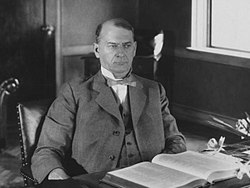 Joseph F. Rutherford, 1911 Bible Students Convention Souvenir Booklet.
If Charles Taze Russell planted a garden, Joseph Franklin Rutherford replaced it with something unrecognizable. In his twenty-five years as president of the Watch Tower Society (1917–1942), Rutherford systematically dismantled the democratic, loosely organized Bible Student movement Russell had created and replaced it with a centralized, authoritarian organization unrecognizable to its founder. He ousted dissenters, eliminated congregational elections, rewrote the doctrines, banned holidays and patriotic symbols, introduced aggressive propaganda methods, built himself a mansion to house resurrected biblical patriarchs, and adopted the name "Jehovah's Witnesses" — all while driving out an estimated three-quarters of Russell's original followers. The Watchtower organization that exists today is, in almost every structural and doctrinal respect, Rutherford's creation.
Early Life and Legal Career
Joseph Franklin Rutherford was born on November 8, 1869, on a farm in Morgan County, Missouri, to Baptist parents.[1] Unlike the relatively prosperous Russell, Rutherford grew up in near poverty. When he was sixteen, his father agreed to let him attend college — on the condition that he pay his own way and hire a laborer to replace him on the farm.[2]
Rutherford pursued law through the old apprentice system, spending two years under the tutelage of Judge E. L. Edwards. He became an official court reporter at age twenty and was admitted to the Missouri bar on May 5, 1892, at age twenty-two.[3] He worked as a trial lawyer, served for four years as a public prosecutor in Boonville, Missouri, and briefly campaigned for Democratic presidential candidate William Jennings Bryan.[4]
At some point after 1895, Rutherford was appointed as a Special Judge in Missouri's Eighth/Fourteenth Judicial Circuit Court, sitting as a substitute when regular judges were unavailable. It was from this appointment — at most a handful of occasions on the bench — that he derived the title "Judge Rutherford" for the rest of his life.[5] The title lent an air of authority and gravitas that proved useful throughout his career.
Conversion and Rise Within the Watch Tower
In 1894, two colporteurs visited Rutherford's law office and sold him the first three volumes of Russell's Millennial Dawn series.[6] He was baptized in 1906 and quickly rose through the ranks. In 1907, he was appointed as the Watch Tower Society's legal counsel, and he also served as a traveling speaker (pilgrim).[7]
Rutherford's legal skills made him invaluable. He was admitted to the New York bar in 1909 and to practice before the U.S. Supreme Court the same year.[8] Critically, it was Rutherford who organized the formation of the People's Pulpit Association in New York in 1909 — a corporation whose charter, drafted by Rutherford himself, gave the president "absolute power and control" of its activities. This charter would later prove a powerful weapon in his consolidation of power.[9]

Coping with toxic family dynamics, estrangement, and rebuilding your life. For anyone dealing with the fallout of leaving a high-control group.
View on Amazon →The Contested Succession (1917)
Russell died on October 31, 1916, leaving no designated successor. On January 6, 1917, at the Pittsburgh convention, Rutherford was elected president of the Watch Tower Society, unopposed. By-laws passed at the convention gave the president the role of executive officer and general manager, with "full charge of its affairs worldwide."[10]
Within months, tensions over his consolidation of authority became apparent. By June 1917, four of the seven board directors — Robert H. Hirsh, Alfred I. Ritchie, Isaac F. Hoskins, and James D. Wright — accused Rutherford of acting in an autocratic manner and attempted to rescind the expanded presidential powers.[11]
Rutherford's response was swift and lawyerly. He obtained a legal opinion from a Philadelphia corporation attorney that the four directors had never been legally elected under the Society's charter, since their appointments had not been confirmed at an annual meeting as required. Using this technicality, he removed all four from the board in July 1917 and replaced them with loyalists.[12]
The ousted directors and their supporters launched a pamphlet war — Rutherford published Harvest Siftings (August 1917); the opposition responded with Light After Darkness. Rutherford then called a referendum vote among all Bible Student congregations in November 1917. Most members supported him: according to one account, of roughly 11,421 votes cast, 10,869 favored Rutherford as president.[13]
The result was a catastrophic schism. By mid-1919, an estimated one in seven of Russell-era Bible Students had ceased their association with the Society. By 1931, an estimated three-quarters had left.[14] Multiple independent Bible Student groups formed, including the Pastoral Bible Institute (1918), the Laymen's Home Missionary Movement, and later the Dawn Bible Students Association (1932).[15]
The Finished Mystery and the Espionage Act (1918)
In July 1917, Rutherford released The Finished Mystery as a seventh volume of Russell's Studies in the Scriptures series. Advertised as Russell's "posthumous work," the book was actually written by Clayton J. Woodworth and George H. Fisher and edited by Rutherford himself.[16] It contained strident anti-war and anti-clergy rhetoric that went far beyond anything Russell had published.
In early May 1918, U.S. Attorney General Thomas Watt Gregory condemned the book as "one of the most dangerous examples of propaganda." Warrants were issued for the arrest of Rutherford and seven other Watch Tower officials under the Espionage Act of 1917, charged with attempting to cause insubordination and obstructing military recruitment during wartime.[17]
On June 21, 1918, seven of them — including Rutherford — were sentenced to twenty years' imprisonment in the federal penitentiary at Atlanta, Georgia.[18] They served approximately nine months before being released on bail in March 1919. In April 1919, an appeals court reversed their convictions, ruling they had been denied an impartial trial. In May 1920, the government dropped all charges.[19]
The imprisonment became a defining narrative for Rutherford. He used it to reinforce the idea that the Bible Students were a persecuted people chosen by God — and that their suffering proved they had divine backing. The Watchtower later taught that Jesus had "inspected" and "chosen" the organization in 1918–1919 during this very period of trial.[20]
"Millions Now Living Will Never Die" and the 1925 Failure
Beginning in 1918, Rutherford launched a spectacular public lecture campaign under the title "Millions Now Living Will Never Die." The material was published as a booklet in 1920. Its central claim: based on a revised calculation of biblical jubilee cycles, 1925 would mark the earthly resurrection of the ancient patriarchs — Abraham, Isaac, Jacob, and other faithful figures from the Hebrew scriptures.[21]
Rutherford stated with confidence: "Therefore we may confidently expect that 1925 will mark the return of Abraham, Isaac, Jacob and the faithful prophets of old."[22] Followers wore sandwich-board signs proclaiming the message in public. The campaign attracted enormous attention — and enormous expectations.
1925 came and went. Abraham did not return. The failure was devastating. Memorial attendance — a key metric of organizational health — plummeted from 88,544 in 1927 to just 17,380 in 1928.[23] It took until approximately 1940 for the organization to recover to pre-1925 membership levels.
Rather than acknowledge the failed prediction, Rutherford deflected responsibility onto the followers: "It was stated in the 'Millions' book that we might reasonably expect them to return shortly after 1925, but this was merely an expressed opinion."[24] The word "confidently" was quietly forgotten.
Beth Sarim: The House of the Princes
Even after the 1925 failure, Rutherford insisted the resurrection of the ancient patriarchs was imminent. In 1929, the Society authorized the construction of Beth Sarim (Hebrew for "House of the Princes"), a ten-bedroom Spanish mansion in the Kensington Heights section of San Diego, California, designed by architect Richard S. Requa at a cost of approximately $25,000.[25]
The property deed, written by Rutherford, stated that it would be held "perpetually in trust" for the Old Testament princes and would be "forever at the disposal of the aforementioned princes on earth."[26] The grounds were landscaped with olive, date, and palm trees — reportedly so that the patriarchs would "feel at home."[27]
In the meantime, Rutherford himself moved in as "caretaker." He lived at Beth Sarim during winters — and eventually year-round — in a style that contrasted sharply with the modest conditions of rank-and-file Witnesses. Newspapers reported his lifestyle, which included a 16-cylinder Cadillac.[28] Former Watch Tower legal counsel Olin R. Moyle wrote Rutherford a letter in 1939 protesting the stark contrast between the accommodations provided to Rutherford and those furnished to ordinary Bethel workers.[29]
Beth Sarim was quietly sold in 1948 — six years after Rutherford's death and twenty-three years after the patriarchs were supposed to arrive.
Consolidation of Autocratic Power
Between 1919 and the mid-1930s, Rutherford systematically dismantled every democratic feature of Russell's organizational structure:
1919: Rutherford instituted the appointment of a "service director" in each congregation — a headquarters loyalist who reported to Brooklyn rather than to the local congregation.[30]
1920: All members were instructed to report their weekly preaching activity to Brooklyn headquarters — the birth of the time-reporting system that persists today.[31]
1925: Rutherford gained full control over doctrinal content. According to one account, he overruled the five-man Editorial Committee's refusal to publish his article "Birth of the Nation," which contained major doctrinal changes. The committee was effectively neutralized, and Rutherford became the sole arbiter of what the Watch Tower taught.[32]
1932: Congregational election of elders was abolished. Elders were now appointed by the Society — ending the democratic polity that had characterized the movement since Russell's day.[33]
The result was a complete inversion of Russell's vision. Where Russell had built a voluntary federation of autonomous study groups united by shared literature, Rutherford created a top-down command structure in which every congregation, every member, and every doctrinal position was controlled from Brooklyn.
The Doctrinal Overhaul
Rutherford did not merely adjust Russell's teachings — he demolished and rebuilt them. Among the major changes:
Christ's invisible presence shifted from 1874 to 1914. Russell had taught that Christ returned invisibly in 1874 and that 1914 was the endpoint. Rutherford gradually repositioned 1914 as the beginning of Christ's presence and the start of the "last days" — the precise opposite of what Russell had taught.[34]
Pyramidology denounced. In 1928, Rutherford declared the Great Pyramid — which Russell had called "God's Stone Witness" — to be "Satan's Bible," built by the Devil to deceive.[35]
The "great crowd" moved from heaven to earth (1935). At a Washington, D.C. convention in 1935, Rutherford rejected Russell's teaching that the "great company" of Revelation 7:9 was a secondary spiritual class destined for heaven. Instead, he taught that the "great multitude" were people who would survive Armageddon and live forever on a paradise earth — but only if they became Jehovah's Witnesses before it began.[36] This created the two-class system (anointed vs. "other sheep") that defines JW theology today.
The cross rejected. Rutherford taught that Jesus died not on a cross but on a torture stake — a teaching unique to Jehovah's Witnesses among Christian-identifying groups.[37]
Holidays, birthdays, and patriotic symbols banned. Christmas celebrations at Bethel — which had continued into the mid-1920s — were prohibited. Birthdays, Easter, Mother's Day, and other observances were condemned as pagan. The flag salute was proscribed in 1935 as a form of idolatry, triggering waves of persecution and mob violence against Witness children in public schools.[38]
The Name "Jehovah's Witnesses" (1931)
At a convention in Columbus, Ohio, on July 26, 1931, Rutherford proposed and adopted the name "Jehovah's witnesses" (based on Isaiah 43:10) to distinguish his followers from the proliferation of independent Bible Student groups that still followed Russell's teachings.[39] The name change served several purposes: it distinguished the group from Russell-era Bible Student associations, emphasized Rutherford's distinctive doctrinal direction, and branded the movement with a name that could not be claimed by rival groups.
Propaganda Methods
Rutherford was a master of confrontational publicity. His methods included:
Phonographs and sound cars: From the late 1920s, Witnesses used portable phonographs to play Rutherford's recorded lectures at doorsteps. Sound cars — vehicles mounted with loudspeakers — broadcast his messages through neighborhoods, often provoking angry reactions.[40]
Aggressive anti-clergy rhetoric: Rutherford's publications attacked Catholic and Protestant clergy with extraordinary venom. His twenty-one books and countless pamphlets described organized religion as a "racket" and clergy as tools of Satan. He wrote in total some 400 million pieces of literature distributed during his presidency.[41]
"Information marches": Witnesses wore sandwich-board signs bearing provocative slogans and marched through city streets. Historians such as Harrison, Schnell, and Whalen have suggested that Rutherford may have intentionally cultivated opposition, using the resulting persecution as evidence of divine favor and as a tool to strengthen followers' commitment to the organization.[42]
Death
Rutherford's health had been poor since his imprisonment in 1918–1919, during which he reportedly lost the use of one lung from pneumonia.[43] He died at Beth Sarim on January 8, 1942, at age seventy-two, of rectal cancer. The cause of death was listed as "uraemia due to carcinoma of the rectum due to pelvic metastasis."[44]
Rutherford had wished to be buried at Beth Sarim or on the adjacent property Beth Shan, but San Diego County officials refused to grant a burial permit. His remains were ultimately shipped to New York and buried on April 25, 1942, at Rossville, Staten Island, in a private Watch Tower burial plot.[45]
At his death, membership stood at approximately 100,000 — a sixfold increase over his presidency despite the massive hemorrhaging of Russell-era members.[46] The membership had largely turned over: the independent-minded Bible Students who valued democratic participation had largely departed, and in their place was a disciplined corps of door-to-door preachers operating under centralized direction from Brooklyn.
Legacy: The Architect of Modern Jehovah's Witnesses
Rutherford's twenty-five-year presidency was the most transformative period in the organization's history. A comparison of what he inherited and what he left behind makes this clear:
| Feature | Inherited from Russell (1916) | Left by Rutherford (1942) |
|---|---|---|
| Organization name | International Bible Students | Jehovah's Witnesses (1931) |
| Governance | Congregational democracy; elected elders | Top-down theocracy; appointed service directors |
| Christ's presence | Began invisibly in 1874 | Began invisibly in 1914 |
| 1914 | The end of worldly governments | The start of the last days |
| Great Pyramid | "God's Stone Witness" | "Satan's Bible" (1928) |
| Holidays | Christmas celebrated at Bethel | All holidays banned as pagan |
| The cross | Accepted; cross-and-crown symbol used | Rejected; Jesus died on a "torture stake" |
| Flag salute | Not prohibited | Banned as idolatry (1935) |
| Heavenly hope | Available to all faithful Christians | Limited to 144,000 "anointed"; rest are "other sheep" with earthly hope |
| Dissent | "Great latitude of belief" tolerated | Dissenters expelled; opposition equated with satanic influence |
The modern Jehovah's Witness organization is, in virtually every respect, Rutherford's creation. Russell may have planted the seed, but Rutherford fundamentally restructured both its doctrine and its governance into something Russell would likely not have recognized.
Timeline
| Date | Event |
|---|---|
| Nov. 8, 1869 | Born on a farm in Morgan County, Missouri[1] |
| May 1892 | Admitted to the Missouri bar[3] |
| 1894 | Purchases first three volumes of Russell's Millennial Dawn[6] |
| 1906 | Baptized as a Bible Student[7] |
| 1907 | Appointed as Watch Tower Society's legal counsel[7] |
| Jan. 6, 1917 | Elected president of the Watch Tower Society, unopposed[10] |
| Jul. 1917 | The Finished Mystery published; four directors ousted from the board[12] |
| Jun. 21, 1918 | Sentenced to 20 years' imprisonment under the Espionage Act[18] |
| Mar. 1919 | Released on bail; convictions later reversed[19] |
| 1920 | Millions Now Living Will Never Die published; predicts patriarchs' return in 1925[21] |
| 1925 | Predicted resurrection of patriarchs fails; massive membership losses follow[23] |
| 1925 | Gains full control over doctrine by overruling Editorial Committee[32] |
| Nov. 1928 | Denounces the Great Pyramid as "Satan's Bible"[35] |
| 1929 | Beth Sarim constructed in San Diego for resurrected patriarchs[25] |
| Jul. 26, 1931 | Name "Jehovah's witnesses" adopted at Columbus, Ohio convention[39] |
| 1932 | Congregational election of elders abolished; appointed service directors replace them[33] |
| 1935 | "Great crowd" doctrine introduced; two-class system established; flag salute banned[36] |
| Jan. 8, 1942 | Dies at Beth Sarim, San Diego, at age 72[44] |
See Also
- Charles Taze Russell (1852–1916) — The founder whose democratic movement Rutherford dismantled
- Early Organizational Structure (1879–1916) — What Rutherford inherited and systematically destroyed
- The 1925 Prophecy Failure — The "Millions" campaign and its catastrophic aftermath
- Bible Student Splinter Groups — The groups that broke away to preserve Russell's original teachings
- Beth Sarim — 'House of the Princes' — Rutherford's San Diego mansion built for resurrected patriarchs
- Watchtower Pyramidology — From "God's Stone Witness" to "Satan's Bible"
- The Governing Body — Structure, History & Power — How Rutherford's autocracy evolved into the modern Governing Body
References
1. ↩ "Joseph Franklin Rutherford," Wikipedia. [en.wikipedia.org]
2. ↩ M. James Penton, Apocalypse Delayed: The Story of Jehovah's Witnesses, 3rd ed. (Toronto: University of Toronto Press, 2015); see also Jan Haugland, "The Successor Problem," Medium. [medium.com]
3. ↩ "Joseph Franklin Rutherford — Early career," Wikipedia. [en.wikipedia.org]
4. ↩ "Joseph Franklin Rutherford," Wikipedia: served four years as public prosecutor in Boonville; campaigned for William Jennings Bryan. [en.wikipedia.org]
5. ↩ "Joseph Franklin Rutherford," Wikipedia: appointed as Special Judge in the 8th/14th Judicial Circuit Court of Missouri. [en.wikipedia.org]
6. ↩ "Joseph Franklin Rutherford," Wikipedia: purchased the first three volumes of Russell's Millennial Dawn from two colporteurs in 1894. [en.wikipedia.org]
7. ↩ "Joseph Franklin Rutherford," Wikipedia: baptized in 1906; appointed legal counsel in 1907. [en.wikipedia.org]
8. ↩ "Joseph Franklin Rutherford," Wikipedia: admitted to New York bar and Supreme Court bar in 1909. [en.wikipedia.org]
9. ↩ "Watch Tower Bible and Tract Society of Pennsylvania," Wikipedia: People's Pulpit Association charter gave president "absolute power and control." [en.wikipedia.org]
10. ↩ "Joseph Franklin Rutherford — Presidency," Wikipedia. [en.wikipedia.org]
11. ↩ "Joseph Franklin Rutherford — Board dispute," Wikipedia: four directors accused Rutherford of autocratic behavior. [en.wikipedia.org]
12. ↩ "Joseph Franklin Rutherford," Wikipedia: Rutherford obtained legal opinion that directors were not legally appointed. [en.wikipedia.org]
13. ↩ Jan Haugland, "The Successor Problem," Medium: of 11,421 votes, 10,869 wanted Rutherford as president. [medium.com]
14. ↩ "Jehovah's Witnesses," Wikipedia: by mid-1919, one in seven had left; between 1921 and 1931, three-quarters departed. [en.wikipedia.org]
15. ↩ "History — Joseph F. Rutherford's Takeover," JwCult.com. [jwcult.com]
16. ↩ "Joseph Franklin Rutherford — The Finished Mystery," Wikipedia. [en.wikipedia.org]
17. ↩ "Joseph Franklin Rutherford — Espionage Act," Wikipedia: Attorney General Gregory condemned the book in May 1918. [en.wikipedia.org]
18. ↩ "Part 8 — International Attempt to Destroy Society Fails," Watchtower ONLINE LIBRARY (1955 Yearbook). [wol.jw.org]
19. ↩ "Joseph Franklin Rutherford," EBSCO Research: convictions reversed April 1919; charges dropped May 1920. [ebsco.com]
20. ↩ "Joseph Franklin Rutherford," Wikipedia: Rutherford taught that Jesus chose the organization during the 1918–1919 period. [en.wikipedia.org]
21. ↩ J. F. Rutherford, Millions Now Living Will Never Die (Brooklyn: International Bible Students Association, 1920), pp. 88–90. [jwfacts.com]
22. ↩ Rutherford, Millions Now Living Will Never Die (1920), pp. 89–90. [jwfacts.com]
23. ↩ "1925 and the Watchtower," JWfacts.com: Memorial attendance dropped from 88,544 (1927) to 17,380 (1928). [jwfacts.com]
24. ↩ The Watchtower, 1926, cited on JWfacts.com. [jwfacts.com]
25. ↩ "Beth Sarim," Wikipedia. [en.wikipedia.org]
26. ↩ Deed of Beth Sarim, published in The Golden Age, March 19, 1930; see "Beth Sarim," Wikipedia. [en.wikipedia.org]
27. ↩ The Messenger, 1931; see "Beth-Sarim: House of Princes," JWfacts.com. [jwfacts.com]
28. ↩ "Beth Sarim," Wikipedia: newspapers reported Rutherford's 16-cylinder Cadillac. [en.wikipedia.org]
29. ↩ Olin R. Moyle, letter to J. F. Rutherford, 1939; cited in "Beth Sarim," Wikipedia. [en.wikipedia.org]
30. ↩ "Jehovah's Witnesses," Wikipedia: in 1919, Rutherford instituted appointment of a director in each congregation. [en.wikipedia.org]
31. ↩ "Jehovah's Witnesses," Wikipedia: in 1920 all members instructed to report preaching activity to Brooklyn. [en.wikipedia.org]
32. ↩ "The Creation of a Theocracy," Mentes Bereanas. [mentesbereanas.info]
33. ↩ "History — Joseph F. Rutherford's Takeover," JwCult.com: elected elders replaced with appointed service directors. [jwcult.com]
34. ↩ "1914 — Failed Watchtower Prophecy," JWfacts.com: Russell taught invisible presence began in 1874; Rutherford shifted it to 1914. [jwfacts.com]
35. ↩ The Watchtower, November 15, 1928, p. 344: "Satan put his knowledge in dead stone, which may be called Satan's Bible." [daenglund.com]
36. ↩ "Joseph Franklin Rutherford," Wikipedia: at the 1935 Washington, D.C. convention, Rutherford reinterpreted the "great multitude" as earthly survivors. [en.wikipedia.org]
37. ↩ "Joseph Franklin Rutherford," Wikipedia: asserted that Christ did not die on a cross. [en.wikipedia.org]
38. ↩ "Joseph Franklin Rutherford," Wikipedia: condemned holidays as pagan; proscribed flag salutes in 1935 as idolatry. [en.wikipedia.org]
39. ↩ "Joseph Franklin Rutherford," Wikipedia: name "Jehovah's witnesses" introduced at Columbus, Ohio convention, July 26, 1931. [en.wikipedia.org]
40. ↩ "Jehovah's Witnesses in the United States," Wikipedia; see also Shawn Francis Peters, Judging Jehovah's Witnesses (2000). [en.wikipedia.org]
41. ↩ "Joseph Franklin Rutherford," Wikipedia: credited with distribution of almost 400 million books and booklets. [en.wikipedia.org]
42. ↩ "Jehovah's Witnesses in the United States," Wikipedia: Harrison, Schnell, and Whalen suggested Rutherford invited opposition for publicity. [en.wikipedia.org]
43. ↩ "Beth Sarim," Wikipedia: Rutherford had lost the use of one lung from pneumonia during imprisonment. [en.wikipedia.org]
44. ↩ "Joseph Franklin Rutherford," Goodreads / Wikipedia: cause of death was "uraemia due to carcinoma of the rectum." [en.wikipedia.org]
45. ↩ "Beth Sarim," Wikipedia: burial permit denied; remains shipped to Rossville, Staten Island, April 25, 1942. [en.wikipedia.org]
46. ↩ "Joseph Franklin Rutherford," Encyclopedia.com: at death, followers numbered about 100,000. [encyclopedia.com]