The Governing Body — Structure, History & Power
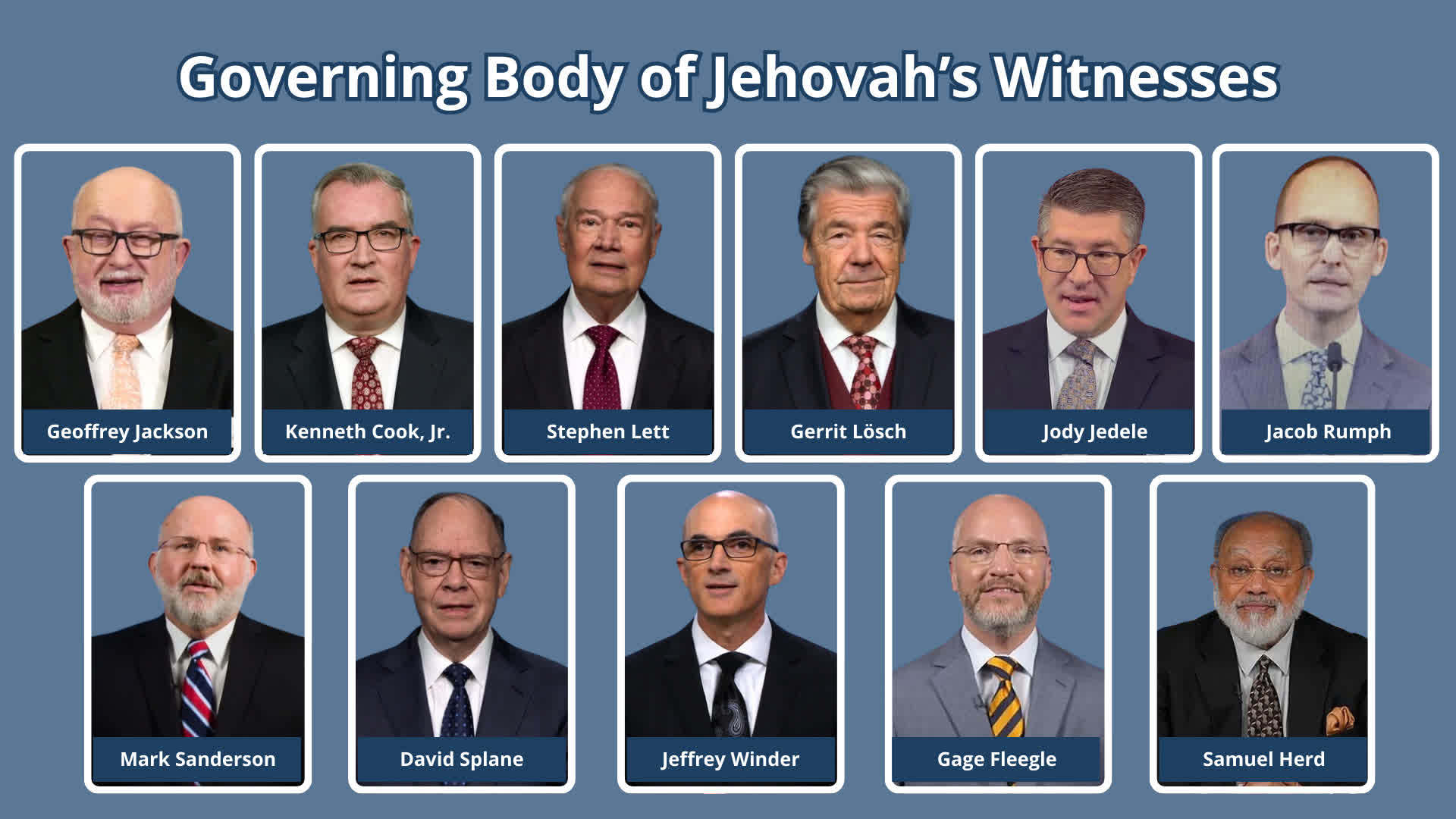 Via Wikimedia Commons.
The Governing Body of Jehovah's Witnesses is a small, all-male group of men who exercise absolute authority over approximately 8.7 million Witnesses worldwide. They control all doctrinal interpretation, all publications, all organizational policy, all judicial procedures, and all appointment of leaders at every level of the hierarchy. They claim to be directed by God's holy spirit and to constitute the sole "faithful and discreet slave" prophesied in Matthew 24:45 — God's exclusive channel of communication on earth. Yet this body has no legal corporate existence, no theological training requirements for membership, no external accountability, no democratic input from the membership it governs, and no mechanism by which its decisions can be appealed. Members appoint their own successors. The term "Governing Body" does not appear in the Bible. The body did not exist in its current form until 1976. For most of the organization's history, absolute power resided in a single man — the president.
Origins: The Myth of Continuity
The Presidential Era (1879–1976)
For the first ninety-seven years of the Watch Tower organization's existence, there was no Governing Body. Power resided exclusively in the president:
- Charles Taze Russell (1879–1916) controlled all publications, all doctrine, and all organizational direction as the sole editor and president.
- Joseph Rutherford (1917–1942) dismissed four of seven board directors in 1917, dissolved the editorial committee in 1931, abolished elected elders in 1932, and ruled as an autocrat for twenty-five years.
- Nathan Knorr (1942–1977) continued the pattern, with the board of directors meeting only sporadically — usually to discuss property purchases or equipment — while Knorr and vice-president Frederick Franz made all doctrinal and publishing decisions between them.[1]
1944: The Term Emerges
The first appearance of the phrase "governing body" (lowercase) in Watchtower literature came in 1944, in connection with a charter amendment that centralized appointment authority.[3] During this period, the "governing body" was simply another name for the Watch Tower Society's seven-member board of directors — not a separate, empowered leadership council. It was a description, not an institution.[4]
The organization today retroactively capitalizes the term "Governing Body" in references to this period, creating the false impression that the formal body has existed since 1944. For example, a 2012 Watchtower described Hugo Riemer, who died in 1965, as "a member of the Governing Body" — six years before the capitalized Governing Body was formally established.[5]
1971: Formal Establishment
On October 1, 1971, Frederick Franz addressed the annual meeting of the Pennsylvania corporation, declaring that the Watch Tower Society was merely an "agency" or "temporary instrument" used by the Governing Body. Three weeks later, on October 20, four additional men joined the seven directors to form a separate, expanded Governing Body of eleven members.[6]
The December 15, 1971 Watchtower was the first publication to capitalize the term "Governing Body of Jehovah's Witnesses" as a defined proper noun.[7]
However, this was largely a cosmetic change. All doctrinal and publishing decisions continued to be made by or subject to the approval of President Knorr. According to Raymond Franz, Governing Body meetings were sometimes as short as seven minutes.[8]
1976: The Power Transfer
The real transformation came on January 1, 1976, when authority was formally transferred from the president to the Governing Body through a committee structure. In December 1975, the Governing Body unanimously voted to establish six operating committees to oversee all aspects of the organization's worldwide operations — functions that had previously been directed solely by the president.[9]
Raymond Franz wrote that the 1976 restructuring was triggered in part by the internal crisis following the 1975 prophecy failure, which had undermined confidence in the existing top-down structure. The Aid to Bible Understanding project (1969–1971), which gave researchers like Raymond Franz access to the organization's doctrinal inconsistencies, also contributed to pressure for collective governance.[10]
Nathan Knorr reportedly resisted the restructuring but accepted it. He died in June 1977. His successor as president, Frederick Franz, found himself in a role that had been stripped of most of its former authority — though Franz's personal influence remained enormous due to his status as the organization's chief theologian.[11]
The Six Committees
Since January 1, 1976, the Governing Body has operated through six committees, each responsible for a major area of organizational activity. Each committee has a chairman who serves for one year, with the chairmanship of the full Governing Body rotating annually in alphabetical order by surname.[12]
| Committee | Responsibility |
|---|---|
| Coordinator's Committee | Legal matters, persecution response, disasters, and other urgent matters requiring immediate action |
| Personnel Committee | Oversight of Bethel family members (staff) worldwide; invitations for new Bethel service; personal and spiritual assistance |
| Publishing Committee | Printing, publishing, and shipping of literature worldwide; oversight of factories, properties, financial operations, and legal/business matters |
| Service Committee | Supervision of all evangelizing work; oversight of congregations, circuit overseers, missionaries, branch committees, and zone overseers |
| Teaching Committee | Audio, video, and online content development; conventions and assembly programs; educational materials and schools |
| Writing Committee | Preparation of all spiritual instruction in printed and electronic form; oversight of translation work |
Since 1992, non-Governing-Body members called "helpers" have been assigned to assist these committees. As of recent years, there are approximately 42 helpers serving alongside the Governing Body members.[14]
Coping with toxic family dynamics, estrangement, and rebuilding your life. For anyone dealing with the fallout of leaving a high-control group.
View on Amazon →The 2000 Corporate Restructuring
In October 2000, the Governing Body took a significant structural step: it separated itself from the boards of directors of the Watch Tower Bible and Tract Society of Pennsylvania and the Watchtower Bible and Tract Society of New York. Governing Body members resigned from these corporate boards, which were then staffed by non-Governing-Body members.[15]
This move served multiple purposes. Critics argue the restructuring served to insulate Governing Body members from personal liability in lawsuits — a growing concern as child sexual abuse cases mounted. Theologically, it reinforced the narrative that the Governing Body was a purely spiritual body, distinct from the legal corporations that served as its "instruments." Practically, the corporate boards continued to operate under the Governing Body's direction.[16]
The 2012 Redefinition: "The Faithful and Discreet Slave"
At the October 2012 Annual Meeting, the Governing Body announced what it presented as a major doctrinal clarification regarding the identity of the "faithful and discreet slave" from Jesus' parable in Matthew 24:45–47.[17]
Before 2012: The "faithful and discreet slave" was understood to be the entire class of "anointed" Jehovah's Witnesses — all those who claimed a heavenly hope. The Governing Body was merely the representative or instrument of this larger class.
After 2012: The "faithful and discreet slave" was redefined as the Governing Body alone. The July 15, 2013 Watchtower stated: "That slave is made up of a small group of anointed brothers who are directly involved in preparing and dispensing spiritual food during Christ's presence. Throughout the last days, the anointed brothers who make up the faithful slave have served together at headquarters."[18]
This was a significant consolidation of authority. Where once the Governing Body could at least theoretically be held accountable to the broader "anointed class," it now declared itself to be the sole entity appointed by Christ — accountable only to Jesus himself. The approximately 20,000 other "anointed" Witnesses worldwide were effectively excluded from the doctrine's scope.
JW Broadcasting and the Cult of Personality
In October 2014, the organization launched JW Broadcasting (tv.jw.org), a monthly internet television program. For the first time in the organization's history, individual Governing Body members became visible, recognizable personalities to the rank and file.[19]
Under the previous system — especially Nathan Knorr's anonymous authorship policy (1942 onward) — the leadership operated behind a deliberate veil of anonymity. Most Witnesses could not have named a single Governing Body member. JW Broadcasting changed this fundamentally. Members now regularly appear on camera delivering talks, conducting interviews, making announcements, and soliciting donations.
How Decisions Are Made
The Governing Body meets weekly, typically on Wednesdays, to review issues, deliberate, and reach conclusions. Decisions are formally made by a two-thirds supermajority vote. All members are expected to support the final decision publicly, regardless of how they voted privately.[20]
Raymond Franz described this process in Crisis of Conscience: decisions on matters affecting the lives of millions of Witnesses were sometimes made with minimal research, limited discussion, and heavy deference to tradition or the personal views of senior members. Franz recounted instances where significant doctrinal positions were adopted despite substantial internal disagreement, with dissenters expected to publicly support positions they privately opposed.[21]
There is no mechanism for rank-and-file Witnesses to participate in, observe, or appeal Governing Body decisions. There is no published voting record. Dissent — even private dissent — from Governing Body teachings is classified as apostasy and can result in disfellowshipping.[22]
Geoffrey Jackson and the Australian Royal Commission
On August 14, 2015, Governing Body member Geoffrey Jackson was compelled to testify under oath before the Australian Royal Commission into Institutional Responses to Child Sexual Abuse (Case Study 29). Jackson had to be subpoenaed after the Watchtower organization initially attempted to prevent his appearance, claiming he was only involved in "translation work" and was irrelevant to the inquiry.[23]
Under questioning by Senior Counsel Angus Stewart, Jackson made several statements that contradicted the organization's published teachings:
When asked, "Do you see yourselves as Jehovah God's spokespeople on earth?" Jackson replied: "That, I think, would seem to be quite presumptuous to say that we are the only spokesperson that God is using."[24]
This was remarkable because the organization's own literature states explicitly: "By word or action, may we never challenge the channel of communication that Jehovah is using today."[25]
Jackson also confirmed under oath that the Governing Body appoints its own members: "That is correct" — contradicting the published teaching that such appointments are directed by Jesus through holy spirit.[26]
He described the Governing Body as "guardians of doctrine" — a term that had never appeared in any Watchtower publication and that significantly downplays the body's actual claimed authority.[27]
The Anthony Morris III Removal (2023)
On February 22, 2023, the organization announced that Anthony Morris III was "no longer serving as a member of the Governing Body." No explanation was given. It was the first such removal since Raymond Franz's departure in 1980.[28]
The speed with which Morris was removed from organizational materials — his photo removed from jw.org the same day, his Morning Worship videos deleted within weeks — led many observers to conclude the departure was disciplinary rather than voluntary. AvoidJW reported footage said to show Morris purchasing alcohol at a liquor store, fueling widespread speculation. The organization has never officially explained the removal.[29]
Current Members
As of late 2024, the Governing Body consists of eleven members:
| Member | Appointed | Notable |
|---|---|---|
| [Gerrit Lösch](15-04-gb-gerrit-losch.php) | 1994 | Longest-serving current member; refused to comply with a court subpoena in a child abuse case, claiming he was "not answerable" to the Watchtower Society |
| Samuel Herd | 1999 | First and only African American member; formerly oversaw Service Committee |
| David Splane | 1999 | Known for "overlapping generations" whiteboard presentation (2015); oversees Teaching Committee |
| Stephen Lett | 1999 | Known for animated speaking style; currently oversees Coordinator's Committee |
| Geoffrey Jackson | 2005 | Testified before Australian Royal Commission (2015); oversees Writing Committee |
| Mark Sanderson | 2012 | Youngest member at time of appointment; oversees Service Committee |
| Kenneth Cook Jr. | 2018 | Oversees Personnel Committee |
| Gage Fleegle | Jan. 2023 | Appointed alongside Jeffrey Winder shortly before Morris's removal |
| Jeffrey Winder | Jan. 2023 | Background in Audio/Video Services and Personnel Committee |
| Jody Jedele | 2024 | Appointed in 2024 |
| Jacob Rumph | 2024 | Appointed in 2024 |
Notable Former Members
| Member | Served | Departure |
|---|---|---|
| Raymond Franz | 1971–1980 | Forced to resign; later disfellowshipped. Author of Crisis of Conscience |
| [Leo Greenlees](15-02-gb-greenlees-chitty.php) | 1965–~1984 | Resigned amid allegations of child sexual abuse |
| [Ewart Chitty](15-02-gb-greenlees-chitty.php) | 1974–~1979 | Resigned amid allegations of homosexuality |
| Anthony Morris III | 2005–2023 | Removed February 22, 2023; no explanation given |
The Authority Claim: A Critique
The Governing Body's authority rests on a chain of claims, each of which depends on the one before it:
Claim 1: Jesus appointed a "faithful and discreet slave" to feed his followers (Matthew 24:45). Critique: Most biblical scholars regard this as a parable about faithfulness, not a prophecy about a future organizational structure. The passage does not describe, name, or authorize any institutional body.
Claim 2: Jesus selected the Watch Tower organization in 1919 as his "faithful and discreet slave" after inspecting all religions. Critique: In 1919, the organization taught that Christ's invisible presence began in 1874 (not 1914), used pyramidology as a prophetic tool, celebrated Christmas, and displayed the cross. If Jesus selected this group based on its teachings, he selected a group whose core doctrines the current organization considers false.
Claim 3: The Governing Body alone constitutes this "faithful slave" (2012 redefinition). Critique: This claim was made by the Governing Body about itself. There is no external validation, no prophetic evidence, and no mechanism by which the claim can be tested or falsified. The Governing Body's authority is ultimately self-asserted and self-perpetuated — its members appoint their own successors, as Geoffrey Jackson confirmed under oath.
Claim 4: The Governing Body is directed by holy spirit and cannot be questioned. Critique: The organization's own history of doctrinal reversals — failed prophecies, the blood doctrine flip-flops, the organ transplant "cannibalism" reversal, the generation doctrine redefinitions — demonstrates that whatever is directing the Governing Body's decisions, it is not an infallible divine source.
Timeline
| Date | Event |
|---|---|
| 1879–1916 | Russell exercises sole authority as president; no governing body exists |
| 1917–1942 | Rutherford rules as autocrat; dismisses directors (1917), dissolves editorial committee (1931) |
| 1944 | Term "governing body" (lowercase) first used in Watchtower literature; applied to board of directors[3] |
| Oct. 20, 1971 | Governing Body formally established as a defined body of 11 members, separate from the board of directors[6] |
| Dec. 15, 1971 | "Governing Body" capitalized for the first time in The Watchtower[7] |
| Dec. 1975 | Governing Body votes to establish six operating committees[9] |
| Jan. 1, 1976 | Committee structure takes effect; power transfers from president to Governing Body[9] |
| May 1980 | Raymond Franz forced to resign from Governing Body[2] |
| 1992 | "Helpers" first assigned to Governing Body committees[14] |
| Oct. 2000 | Governing Body members resign from Watch Tower corporate boards; legal separation of spiritual and corporate functions[15] |
| Oct. 2012 | Governing Body declares itself the sole "faithful and discreet slave"; other anointed excluded[17] |
| Oct. 2014 | JW Broadcasting launched; Governing Body members become visible media personalities[19] |
| Aug. 14, 2015 | Geoffrey Jackson testifies under subpoena before Australian Royal Commission[23] |
| Jan. 18, 2023 | Gage Fleegle and Jeffrey Winder appointed to Governing Body[30] |
| Feb. 22, 2023 | Anthony Morris III removed from Governing Body without explanation[28] |
| 2024 | Jody Jedele and Jacob Rumph appointed; Governing Body reaches 11 members[30] |
See Also
- Raymond Franz & Crisis of Conscience — The insider account of Governing Body operations
- The 1980 Bethel Purge — The crackdown on internal dissent following 1975
- Watchtower Presidents — From one-man rule to collective governance
- The Faithful and Discreet Slave Doctrine — The biblical basis (and problems) of the authority claim
- Child Sexual Abuse Scandals — Including the Australian Royal Commission
- Disfellowshipping & Shunning — The enforcement mechanism protecting Governing Body authority
- Information Control — How the Governing Body maintains its narrative
- Early Governing Body Members (1971–1976)
- Leo Greenlees & Ewart Chitty — Scandal and Silence
- Theodore 'Ted' Jaracz (1925–2010)
- Gerrit Lösch
- Geoffrey Jackson & the Australian Royal Commission
- Anthony Morris III — Rise, Removal & Mystery
- The Current Governing Body
- Governing Body Members (1977–2005)
References
1. ↩ Raymond Franz, Crisis of Conscience (Commentary Press, 2000), pp. 42–108: board of directors met sporadically; Knorr and Franz made all major decisions. [en.wikipedia.org]
2. ↩ Raymond Franz, Crisis of Conscience, pp. 42–108. [en.wikipedia.org]
3. ↩ The Watchtower, November 1, 1944; cited by Raymond Franz, Crisis of Conscience, p. 74 footnote. [en.wikipedia.org]
4. ↩ "Was there a Governing Body Overseeing First Century Christians?", JWfacts.com: until 1971, the term was uncapitalized and referred to the board's operational function. [jwfacts.com]
5. ↩ The Watchtower, August 15, 2012, p. 31: retroactively capitalizes "Governing Body" for Hugo Riemer, who died in 1965. Cited on JWfacts.com. [jwfacts.com]
6. ↩ "Governing Body of Jehovah's Witnesses," Wikipedia: Frederick Franz addressed the October 1, 1971 annual meeting; four additional men joined October 20, 1971. [en.wikipedia.org]
7. ↩ "A Governing Body as Different from a Legal Corporation," The Watchtower, December 15, 1971, p. 755. [en.wikipedia.org]
8. ↩ Raymond Franz, Crisis of Conscience: meetings were sometimes as short as seven minutes. [en.wikipedia.org]
9. ↩ 1977 Yearbook of Jehovah's Witnesses, "The Governing Body of Jehovah's Witnesses": December 4, 1975 vote; committees began functioning January 1, 1976. [jw.org]
10. ↩ Raymond Franz, Crisis of Conscience: the Aid to Bible Understanding project exposed doctrinal inconsistencies; pressure for restructuring grew after 1975 failure. [en.wikipedia.org]
11. ↩ "History of Jehovah's Witnesses," Wikipedia: the 1976 restructuring transferred power from the presidency to the Governing Body committee system. [en.wikipedia.org]
12. ↩ 1977 Yearbook of Jehovah's Witnesses: chairmanship rotates annually in alphabetical order by surname. [jw.org]
13. ↩ "Organizational structure of Jehovah's Witnesses," Wikipedia; supplemented by AvoidJW.org, "Governing Body Committees 2024." [en.wikipedia.org]
14. ↩ "The Governing Body of Jehovah's Witnesses," AvoidJW.org: 42 helpers as of recent years. [avoidjw.org]
15. ↩ "Governing Body of Jehovah's Witnesses," Wikipedia: 2000 corporate restructuring separated GB from Watch Tower Society boards. [en.wikipedia.org]
16. ↩ "Organizational structure of Jehovah's Witnesses," Grokipedia: the restructuring insulated GB members from legal liability while maintaining their actual control. [grokipedia.com]
17. ↩ "Who Really Is the Faithful and Discreet Slave?", The Watchtower, July 15, 2013. [jwfacts.com]
18. ↩ The Watchtower, July 15, 2013: "That slave is made up of a small group of anointed brothers who are directly involved in preparing and dispensing spiritual food during Christ's presence." [watchtowerdocuments.org]
19. ↩ JW Broadcasting launched October 2014 at tv.jw.org. [avoidjw.org]
20. ↩ "Governing Body of Jehovah's Witnesses," Grokipedia: decisions reached through deliberation aimed at unanimity; weekly meetings typically held Wednesdays. [grokipedia.com]
21. ↩ Raymond Franz, Crisis of Conscience: described decision-making with minimal research and heavy deference to tradition. [en.wikipedia.org]
22. ↩ September 1, 1980 Governing Body letter: private disagreement with Watch Tower doctrine constitutes apostasy. [en.wikipedia.org]
23. ↩ Australian Royal Commission into Institutional Responses to Child Sexual Abuse, Case Study 29; Jackson testified August 14, 2015 under subpoena. [preachfromthehousetops.com]
24. ↩ Geoffrey Jackson testimony, August 14, 2015, Australian Royal Commission, Case Study 29 transcript. [jwwatch.org]
25. ↩ The Watchtower, November 15, 2009: "By word or action, may we never challenge the channel of communication that Jehovah is using today." [watchtowerdocuments.org]
26. ↩ Jackson confirmed under oath: "That is correct" — the Governing Body appoints new members of the Governing Body. [cultnews101.com]
27. ↩ Jackson described the Governing Body as "guardians of doctrine" — a phrase never used in any Watchtower publication. [anointedjw.org]
28. ↩ JW.org newsroom announcement, February 22, 2023: "Anthony Morris III is no longer serving as a member of the Governing Body." [avoidjw.org]
29. ↩ "Anthony Morris III Removed from the Governing Body," AvoidJW.org: page updated same day; Morning Worship videos removed within weeks; liquor store footage cited. [avoidjw.org]
30. ↩ "Governing Body of Jehovah's Witnesses," Wikipedia: current membership as of October 2024 includes 11 members. [en.wikipedia.org]
31. ↩ "The Governing Body of Jehovah's Witnesses," AvoidJW.org: four expulsions — Greenlees, Chitty, Raymond Franz, and Anthony Morris III. [avoidjw.org]