Bible Student Splinter Groups
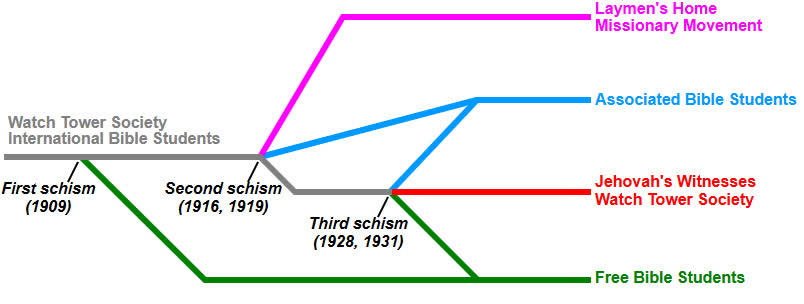 Early Bible Student movement. Via Wikimedia Commons.
When Joseph Rutherford seized control of the Watch Tower Society in 1917 and began dismantling the democratic, decentralized movement Charles Taze Russell had built, the result was not silent compliance — it was a mass exodus. By 1931, an estimated three-quarters of the approximately 50,000 Bible Students who had been associated with the Society in 1917 had departed. These were not disgruntled individuals drifting away; they were organized groups of believers who considered Rutherford's changes a betrayal of Russell's teachings and his autocratic methods a violation of the congregational democracy Russell had championed. The groups they formed — the Pastoral Bible Institute, the Laymen's Home Missionary Movement, the Dawn Bible Students Association, and numerous smaller fellowships — continue to exist today, quietly preserving Russell-era teachings that modern Jehovah's Witnesses have long since abandoned. Their continued existence raises questions the Watchtower has largely avoided addressing in its publications.
The Scope of the Schism
The scale of the departures under Rutherford's presidency is staggering — and consistently understated by the Watchtower organization.
By mid-1919, approximately one in seven Bible Students had already left rather than accept Rutherford's leadership, forming groups such as the Stand Fast Movement and the Pastoral Bible Institute.[1] But this was only the beginning. The 1925 prophecy failure and Rutherford's ongoing doctrinal and organizational changes drove thousands more out through the 1920s.
William Schnell, author and former Jehovah's Witness, estimated that three-quarters of the original Bible Students who had been associating with the Watch Tower Society in 1919 had left by 1931.[2] In 1930, Rutherford himself acknowledged that "the total number of those who have withdrawn from the Society... is comparatively large."[3] The Watch Tower of December 1, 1927, stated that "the larger percentage" of original Bible Students had by then departed.[4]
It was precisely to distinguish his diminished but now compliant following from these independent groups that Rutherford adopted the name "Jehovah's witnesses" at the Columbus, Ohio convention on July 26, 1931. As historian Alan Rogerson observed: "In order to distinguish clearly his followers from the other groups who had separated in 1918 Rutherford proposed that they adopt an entirely new name."[5]
The Major Splinter Groups
Pastoral Bible Institute (1918)
The Pastoral Bible Institute (PBI) was the first significant organized breakaway. It was founded by the four ousted Watch Tower directors — Robert H. Hirsh, Alfred I. Ritchie, Isaac F. Hoskins, and James D. Wright — along with approximately fifty colleagues and supporters who had opposed Rutherford's consolidation of power.[6]
In 1918, the former directors held the first Bible Student Convention independent of the Watch Tower Society. At a second convention shortly after — held at Asbury Park, New Jersey, in July 1918 — the informal Pastoral Bible Institute was organized and, according to one account, incorporated under New York law.[7]
The PBI began publishing The Herald of Christ's Kingdom in December 1918, edited by Randolph E. Streeter. An editorial committee continues publication today, along with reprints of Russell's six-volume Studies in the Scriptures.[8]
The PBI's organizational structure reflects Russell's original vision: governance is very loose, with individuals and autonomous local congregations affiliated through the Herald and an annual meeting at which a seven-member board and five-member editorial committee are elected. The PBI emphasizes evangelism — not just the perfecting of existing believers — and maintains that the invitation to the heavenly hope remains open, in contrast to the Watchtower's post-1935 teaching that the "heavenly calling" was essentially closed.[9]
Laymen's Home Missionary Movement (1919)
Paul S. L. Johnson (1873–1950) was a former Lutheran minister who became one of Russell's most prominent traveling speakers ("pilgrims"). Russell dispatched Johnson to England shortly before his death in 1916 to oversee the International Bible Students Association there. Johnson used the authority Russell had granted him to fire two managers of the London office — an action Rutherford viewed as a direct threat to his own consolidation of power.[10]
After being expelled by Rutherford on July 27, 1917, Johnson founded the Laymen's Home Missionary Movement (LHMM) in 1919, headquartered in Chester Springs, Pennsylvania.[11] Johnson claimed that Russell had intended him to be his true successor and that he held a special role as the "steward of the penny" mentioned in Jesus's parable at Matthew 20:1–16.
The LHMM became one of the larger Bible Student splinter groups, with an estimated 20,000–30,000 followers (up to 40,000 including sympathizers) at its peak during the 1960s. Poland hosts the largest branch, with approximately 6,000 dedicated members. Current worldwide membership is estimated at 10,000–15,000 active adherents.[12]
Johnson's death in 1950 led to further internal splintering. Disagreements over his role as a divinely chosen teacher produced several sub-groups, including the Epiphany Bible Students Association and the Laodicean Home Missionary Movement.[13]
Dawn Bible Students Association (1929/1932)
The Dawn Bible Students Association emerged from a different impulse: not a direct clash with Rutherford's leadership, but a determination to preserve Russell's published legacy.
In 1927, the Watch Tower Society officially ceased publication of Russell's Studies in the Scriptures — effectively erasing the founder's core works from the organization's literature catalog.[14] In 1928, Norman Woodworth — who had been in charge of the Society's radio ministry — left over disagreements with Rutherford's new policies. Woodworth created an independent Bible Students radio program called Frank and Ernest, initially sponsored by the Brooklyn congregation of Associated Bible Students.[15]
In 1929, Woodworth's group sponsored the "First Annual Reunion Convention of Bible Students" at the old Bible House in Pittsburgh that Russell had used — a symbolically potent act of reconnection with the movement's origins.[16]
In 1932, Woodworth and others formally founded Dawn Publishers, Inc. in Brooklyn, New York, just blocks from Watch Tower headquarters. The organization was later renamed the Dawn Bible Students Association and relocated to East Rutherford, New Jersey. Its primary purpose was to resume publication of the Studies in the Scriptures and to produce The Dawn — A Herald of Christ's Presence magazine.[17]
The Dawn became the largest segment of the Bible Student movement outside the Watch Tower Society. At its peak in the 1950s, the Frank and Ernest radio program reportedly aired on as many as 352 stations through the Mutual Broadcasting System.[18] Membership in 2004 was reported at approximately 60,000.[19]
Stand Fast Bible Students Association (1918)
In December 1918, Charles E. Heard and others in Portland, Oregon, broke from the Society over Rutherford's position on the purchase of war bonds — which they considered a perversion of Russell's pacifist teachings. They named themselves the Stand Fast Bible Students Association, reflecting their determination to "stand fast" on Russell's original principles.[20] The group eventually dwindled and was disbanded.
Other Groups
Numerous smaller groups also formed during and after the Rutherford era:
The Elijah Voice Society was founded in 1923 by John A. Herdersen and C. D. McCray, noted for their preaching and pacifist activity.[21]
The Berean Bible Institute (Australia) formally separated from the Watch Tower Society in 1918, publishing The Voice and later the People's Paper magazine.[22]
The New Covenant Fellowship formed in 1909 in Melbourne, Australia (predating the Rutherford schism), after Ernest C. Henninges protested Russell's reversal on the New Covenant doctrine. The related New Covenant Believers (later the Berean Bible Students Church) formed in the U.S. the same year.[23]
The Christian Millennial Fellowship (originally the Italian Bible Students Association) withdrew support from the Watch Tower Society in 1928 in Hartford, Connecticut.[24]
Free Bible Students in Germany, Austria, and Switzerland were organized by Conrad C. Binkele, former Watch Tower branch manager, in 1928. They published Der Pilgrim from 1931 to 1934 and were persecuted during World War II alongside Jehovah's Witnesses.[25]

Coping with toxic family dynamics, estrangement, and rebuilding your life. For anyone dealing with the fallout of leaving a high-control group.
View on Amazon →What the Splinter Groups Retained vs. What Rutherford Changed
The Bible Student groups are not merely organizational rivals of the Watchtower — they are doctrinal time capsules, preserving Russell-era teachings that the modern Jehovah's Witness organization has abandoned. The contrast is striking:
| Doctrine/Practice | Bible Student Groups (Russell's Teaching) | Jehovah's Witnesses (Post-Rutherford) |
|---|---|---|
| Christ's invisible presence | Began in 1874[26] | Began in 1914 |
| 1914 | The end of the Gentile Times | The start of the last days |
| Great Pyramid | Many still regard it as "God's Stone Witness"[27] | Denounced as "Satan's Bible" (1928) |
| Heavenly hope | Open to all faithful Christians | Limited to 144,000 "anointed"; rest have earthly hope only |
| Congregational governance | Autonomous congregations; elected elders; democratic votes[28] | Centralized Governing Body; appointed elders |
| Holidays | Christmas and birthdays generally permitted | All holidays banned as pagan |
| The cross | Accepted; cross-and-crown symbol still used by some groups | Rejected; Jesus died on a "torture stake" |
| Disfellowshipping/shunning | No formal judicial committees; fellowship may be limited but no mandatory shunning | Mandatory shunning enforced through judicial committees |
| Studies in the Scriptures | Still published and studied as foundational texts[14] | Ceased publication in 1927; largely forgotten by members |
| Organization's role | "A business convenience in disseminating the truth" | God's sole channel of communication; membership required for salvation |
The existence of these groups raises significant questions for the Watchtower's narrative. If the Watch Tower Society was divinely guided from Russell's era through to the present, why did the vast majority of Russell's original followers reject Rutherford's changes and leave? And if Russell's teachings were "truth" when he taught them, why were so many of them reversed by his successor — and why do independent Bible Students who preserved those teachings continue to operate outside the organization?
The Watchtower's Response
The modern Watchtower organization has dealt with the Bible Student groups primarily by not acknowledging their existence. Their literature identifies "Bible Students" only as a former name for Jehovah's Witnesses, without acknowledging the continued existence of independent Bible Student groups.[29]
In 1955, the Watch Tower Society classified those who had broken affiliation during Rutherford's presidency as the "evil slave" of Matthew 24:48–51.[30] This teaching was quietly discarded in 2013, when the "evil slave" was redefined as a hypothetical warning rather than an identifiable group.[31]
The Proclaimers book (1993) characterizes those who departed as "chaff" blown away by tests of faith — a framing that treats organizational loyalty as the measure of spiritual worth.[32]
Bible Student Groups Today
By the end of the 20th century, Jehovah's Witnesses claimed a membership of approximately 6 million (now over 9 million), while all independent Bible Student groups combined had an estimated total of fewer than 75,000.[33] The numerical comparison is misleading, however. The Bible Student groups never adopted Rutherford's aggressive recruitment tactics, mandatory door-to-door service, or the social pressure systems that drive Witness growth. They remained what Russell intended: voluntary fellowships of individuals engaged in Bible study, without the organizational machinery — or the coercive retention mechanisms — of the modern Watchtower.
The major groups active today include the Dawn Bible Students Association (East Rutherford, New Jersey), the Pastoral Bible Institute (publishing The Herald of Christ's Kingdom), the Laymen's Home Missionary Movement (Chester Springs, Pennsylvania), and numerous autonomous Associated Bible Students congregations worldwide. They hold annual conventions, maintain websites, and continue to publish Russell's Studies in the Scriptures — the very books the Watchtower stopped printing nearly a century ago.
Timeline
| Date | Event |
|---|---|
| Oct. 1909 | New Covenant Fellowship forms in Melbourne after Henninges protests Russell's doctrinal reversal[23] |
| Oct. 31, 1916 | Russell dies; succession crisis begins |
| Jan. 6, 1917 | Rutherford elected Watch Tower Society president |
| Jul. 1917 | The Finished Mystery published; four directors ousted; pamphlet war begins[1] |
| Jul. 1918 | Pastoral Bible Institute formally organized at Asbury Park, New Jersey[7] |
| Dec. 1918 | PBI begins publishing The Herald of Christ's Kingdom; Stand Fast Bible Students form in Portland, Oregon[8] |
| 1918 | Australian Berean Bible Institute formally separates from the Watch Tower Society[22] |
| 1919 | Paul S. L. Johnson founds the Laymen's Home Missionary Movement[11] |
| By mid-1919 | One in seven Bible Students has left the Watch Tower Society[1] |
| 1923 | Elijah Voice Society founded[21] |
| 1925 | 1925 prophecy fails; massive additional departures follow[34] |
| 1927 | Watch Tower Society ceases publication of Russell's Studies in the Scriptures[14] |
| 1928 | Norman Woodworth leaves Watch Tower; creates independent Frank and Ernest radio program; Christian Millennial Fellowship and Free Bible Students (Germany) also form[15] |
| 1929 | First Annual Reunion Convention of Bible Students held at Russell's old Bible House in Pittsburgh[16] |
| By 1931 | Estimated three-quarters of original Bible Students have left the Watch Tower Society[2] |
| Jul. 26, 1931 | Rutherford adopts name "Jehovah's witnesses" to distinguish his followers from independent Bible Students[5] |
| 1932 | Dawn Publishers, Inc. founded in Brooklyn; begins republishing Studies in the Scriptures[17] |
See Also
- Charles Taze Russell (1852–1916) — The founder whose teachings the splinter groups sought to preserve
- Early Organizational Structure (1879–1916) — The democratic movement Rutherford dismantled
- Joseph Franklin 'Judge' Rutherford (1869–1942) — The autocrat whose power grab drove the schism
- The 1925 Prophecy Failure — The failed prediction that accelerated departures
- The Governing Body — Structure, History & Power — The centralized authority that replaced Russell's democratic polity
- Disfellowshipping & Shunning — Complete History — The coercive retention system the Bible Students never adopted
References
1. ↩ "Bible Student movement," Wikipedia: by mid-1919, about one in seven Bible Students had left. [en.wikipedia.org]
2. ↩ William Schnell, cited in "Bible Student movement," Wikipedia: three-quarters had left by 1931. [en.wikipedia.org]
3. ↩ J. F. Rutherford, 1930, cited in "Bible Student movement," Wikipedia. [en.wikipedia.org]
4. ↩ The Watch Tower, December 1, 1927, p. 355. [en.wikipedia.org]
5. ↩ Alan Rogerson, Millions Now Living Will Never Die: A Study of Jehovah's Witnesses (London: Constable, 1969), pp. 55–56. [en.wikipedia.org]
6. ↩ "Bible Student Groups," Encyclopedia.com. [encyclopedia.com]
7. ↩ "Jehovah's Witnesses splinter groups," Grokipedia: PBI organized at July 1918 Asbury Park convention. [grokipedia.com]
8. ↩ "Bible Student movement," Wikipedia: PBI began publishing The Herald of Christ's Kingdom in December 1918. [en.wikipedia.org]
9. ↩ "Bible Student Groups," Encyclopedia.com: PBI emphasizes evangelism and maintains open heavenly hope. [encyclopedia.com]
10. ↩ "Bible Student Groups," Encyclopedia.com: Johnson dismissed two London office managers. [encyclopedia.com]
11. ↩ "Bible Student movement," Wikipedia: Paul S. L. Johnson founded the LHMM in 1919. [en.wikipedia.org]
12. ↩ "Jehovah's Witnesses splinter groups," Grokipedia: LHMM peaked at 20,000–30,000; current estimate 10,000–15,000; Poland branch ~6,000. [grokipedia.com]
13. ↩ "Bible Student movement," Wikipedia: Johnson's death led to Epiphany Bible Students Association and Laodicean Home Missionary Movement. [en.wikipedia.org]
14. ↩ "Dawn Bible Students Association," Wikipedia: Watch Tower Society ceased publishing Studies in the Scriptures in 1927. [en.wikipedia.org]
15. ↩ "Bible Student movement," Wikipedia: Norman Woodworth left in 1928 and created the Frank and Ernest radio program. [en.wikipedia.org]
16. ↩ "Bible Student movement," Wikipedia: 1929 First Annual Reunion Convention at Russell's old Bible House. [en.wikipedia.org]
17. ↩ "Dawn Bible Students Association," Wikipedia: founded in 1932 in Brooklyn. [en.wikipedia.org]
18. ↩ "Dawn Bible Students Association," Grokipedia: Frank and Ernest aired on 352 stations in the 1950s. [grokipedia.com]
19. ↩ Drew Blankman and Todd Augustine, eds., Pocket Dictionary of North American Denominations (2004), p. 79: approximately 60,000 members. [en.wikipedia.org]
20. ↩ "Bible Student movement," Wikipedia: Stand Fast Bible Students formed in Portland, Oregon, December 1918. [en.wikipedia.org]
21. ↩ "Bible Student movement," Wikipedia: Elijah Voice Society founded in 1923. [en.wikipedia.org]
22. ↩ "Bible Student movement," Wikipedia: Australian Berean Bible Institute formally separated in 1918. [en.wikipedia.org]
23. ↩ "Bible Student movement," Wikipedia: Henninges' 1909 departure and formation of the New Covenant Fellowship. [en.wikipedia.org]
24. ↩ "Bible Student movement," Wikipedia: Italian Bible Students Association withdrew in 1928. [en.wikipedia.org]
25. ↩ "Bible Student movement," Wikipedia: Conrad C. Binkele founded Free Bible Students in Germany, Austria, and Switzerland in 1928. [en.wikipedia.org]
26. ↩ "Jehovah's Witnesses splinter groups," Grokipedia: Bible Student groups share nontrinitarianism, annihilationism, and emphasis on Christ's invisible presence beginning in 1874. [grokipedia.com]
27. ↩ M. James Penton, Apocalypse Delayed, 3rd ed. (2015); several schismatic Bible Student groups still advocate pyramidology.
28. ↩ "Jehovah's Witnesses splinter groups," Grokipedia: groups maintain independent ecclesias focused on Russell's teachings. [grokipedia.com]
29. ↩ "Bible Student movement," Wikipedia: modern Watchtower literature identifies "Bible Students" only as a former name for JWs. [en.wikipedia.org]
30. ↩ "Bible Student movement," Wikipedia: in 1955, the Watch Tower classified those who broke affiliation as the "evil slave." [en.wikipedia.org]
31. ↩ "Bible Student movement," Wikipedia: in 2013, "evil slave" redefined as hypothetical warning. [en.wikipedia.org]
32. ↩ Jehovah's Witnesses — Proclaimers of God's Kingdom (1993), p. 633. [jwfacts.com]
33. ↩ "Bible Student movement," Wikipedia: by end of 20th century, independent Bible Student groups had estimated total of fewer than 75,000. [en.wikipedia.org]
34. ↩ "1925 and the Watchtower," JWfacts.com. [jwfacts.com]