The "Faithful and Discreet Slave" — Shifting Identity
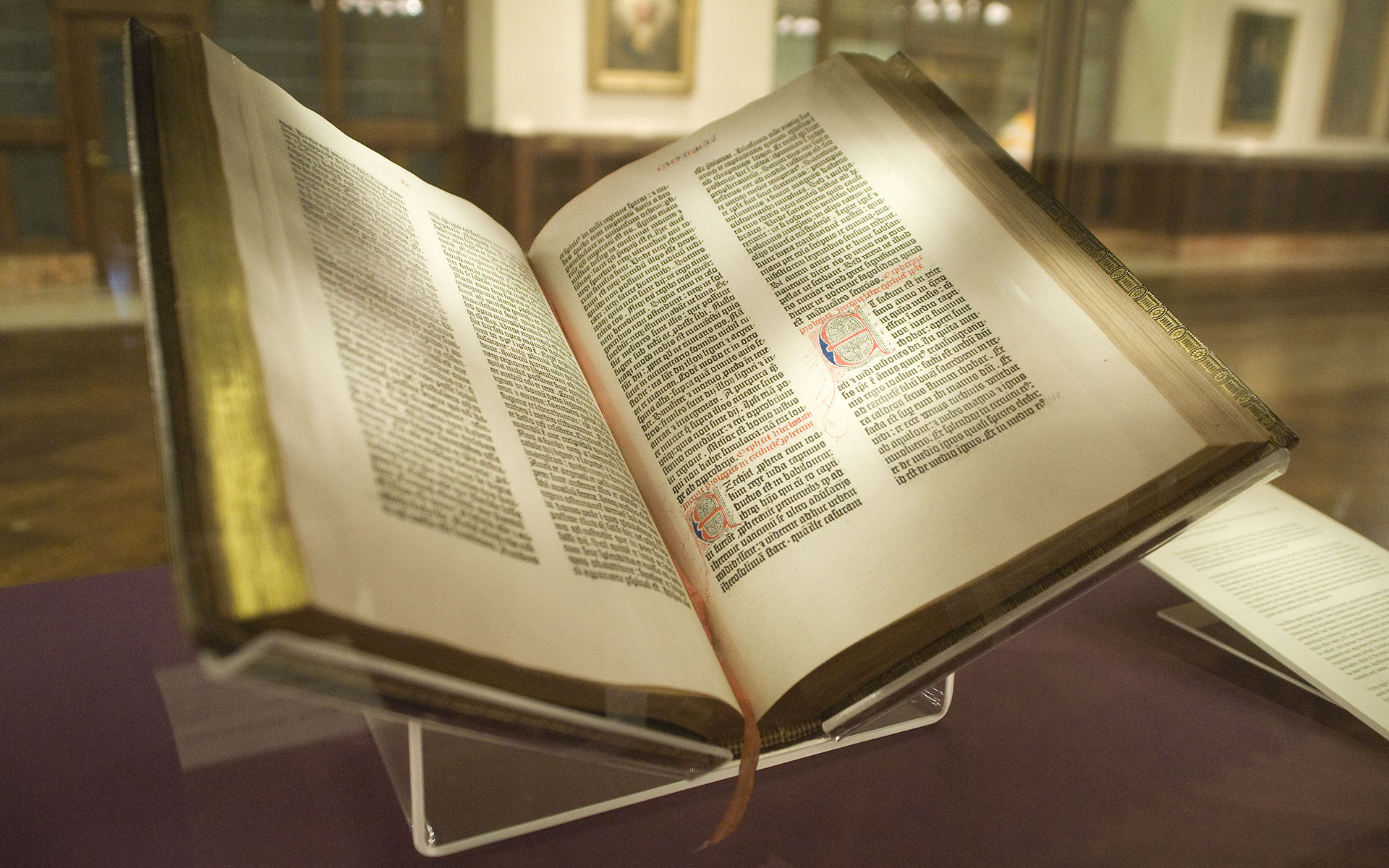 Gutenberg Bible, Lenox Copy, NYPL. Photo by NYC Wanderer. CC-BY-SA 3.0.
"Who really is the faithful and discreet slave whom his master appointed over his domestics, to give them their food at the proper time?" — Matthew 24:45
This single parable — a brief illustration in which Jesus describes a trustworthy household servant — has been transformed by the Watchtower organization into the sole foundation of its claim to divine authority over 8.7 million people. The organization teaches that Jesus was not telling a parable about faithfulness in general, but prophesying the specific appointment of a specific group of men who would serve as God's exclusive channel of communication on earth. That group, the organization now claims, is the Governing Body of Jehovah's Witnesses — and it alone. The identity of this "slave" has changed at least four times: from Charles Taze Russell personally, to all 144,000 anointed Christians, to the Governing Body as "representatives" of the anointed, to the Governing Body exclusively. Each change consolidated more power into fewer hands. The 2012 redefinition — in which the Governing Body declared itself to be the sole faithful slave, stripping the other ~20,000 anointed Witnesses of any doctrinal significance — was a small group of men declaring, about themselves, that Jesus had appointed them to rule.
The Parable in Context
In Matthew 24:45–51, Jesus tells a brief parable as part of his discourse on the Mount of Olives. He describes a slave (Greek: doulos) who is put in charge of feeding the master's household. If the slave is faithful when the master returns, he will be rewarded with greater responsibility. If the slave is wicked — beating fellow slaves and getting drunk — the master will punish him severely.
Most biblical scholars read this as a parable about faithfulness and accountability — an illustration directed at Jesus' disciples urging them to be diligent in his absence. It is not understood by mainstream scholarship as a prophecy about a future institutional structure.[1]
The Watchtower, however, reads it as a prophecy: a prediction that in the last days, Jesus would appoint a specific group to serve as his sole channel for dispensing "spiritual food" to all Christians on earth. This interpretation is the linchpin of the organization's entire authority claim.
The Changing Identity of the "Slave"
Phase 1: Charles Taze Russell — "That Servant" (1881–1927)
In 1881, Russell initially identified the "faithful and wise servant" with the entire body of Christ — "that 'little flock' of consecrated servants who are faithfully carrying out their consecration vows."[2]
However, as Russell's influence grew, his followers increasingly identified him personally as the prophesied servant. Russell himself did not openly discourage this identification, and by the time of his death in 1916, it was widely accepted among Bible Students that Russell was "that faithful and wise servant" of Matthew 24:45.[3]
The 1917 book The Finished Mystery — published posthumously in Russell's name — explicitly stated that Russell was the faithful servant and described him as continuing to supervise the "harvest work" even from beyond the grave.[4]
Phase 2: All Anointed Christians (1927–2012)
After consolidating his power, Joseph Rutherford had no interest in perpetuating the cult of Russell's personality. In 1927, Rutherford reversed the individual identification and declared that the "faithful servant" was not one man but the entire body of spirit-anointed Christians — the 144,000 who would rule with Christ in heaven.[5]
This became the standard teaching for the next 85 years. The "slave" was a class — all anointed Witnesses collectively — that had existed continuously since Pentecost 33 C.E. The Watch Tower Society (and later the Governing Body) served as the "representative" of this class, dispensing spiritual food on its behalf. A 1990 Watchtower stated: "Collectively, spirit-anointed Christians were to be the master's steward, or house manager, assigned to dispense timely spiritual food to the individual members of the household of God."[6]
Importantly, under this teaching, the "domestics" — those being fed — were understood to be the individual anointed Witnesses. The "other sheep" (non-anointed Witnesses with an earthly hope) were not even part of the parable's cast.
In 1981, the Watchtower explicitly rejected the idea that the "slave" referred to the leadership alone: "The objectors may argue that not all of Christ's anointed disciples have a share in preparing the spiritual food, so that perhaps the 'slave' pictures only the leading ones, and the 'domestics' those they serve in the congregation. There is no point in trying to force an interpretation of the parable. Self-deception is of no benefit and is spiritually damaging. ... Thus we see a clear Scriptural basis for saying that all anointed followers of Christ Jesus make up God's 'servant,' with Jesus as its Master."[7]
This 1981 statement is devastating in light of what happened in 2012. The organization explicitly described the very interpretation it would later adopt as "forcing" the parable and engaging in "self-deception."
The Gradual Erosion (2009–2012)
The transition to the 2012 teaching did not happen overnight. Beginning around 2009, subtle shifts in Watchtower language began separating the Governing Body from the broader anointed class:
February 2009: "The faithful and discreet slave today is represented by the Governing Body."[8]
June 2009: "The slave refers only to the Governing Body of Jehovah's Witnesses."[9]
February 2009: "Should not individual members of the anointed... trust the slave appointed over them?" — a remarkable formulation positioning the Governing Body above the anointed class it supposedly represented.[10]
Phase 3: The Governing Body Exclusively (2012–Present)
At the 128th Annual Meeting on October 6, 2012, the Governing Body announced what it presented as a major doctrinal clarification. The July 15, 2013 Watchtower published the details:
"Who, then, is the faithful and discreet slave? In keeping with Jesus' pattern of feeding many through the hands of a few, that slave is made up of a small group of anointed brothers who are directly involved in preparing and dispensing spiritual food during Christ's presence. Throughout the last days, the anointed brothers who make up the faithful slave have served together at headquarters. In recent decades, that slave has been closely identified with the Governing Body of Jehovah's Witnesses."[11]
The announcement included three additional redefinitions:
| Element | Before 2012 | After 2012 |
|---|---|---|
| The "faithful slave" | All ~144,000 anointed Christians throughout history, from Pentecost 33 C.E. onward | The Governing Body alone — a handful of men at world headquarters |
| The "domestics" | Individual anointed Christians being fed by the slave class | All Jehovah's Witnesses — both anointed and "other sheep" (8.7 million people) |
| Timing of appointment | Pentecost 33 C.E. — continuous existence for nearly 2,000 years | 1919 — appointed by Christ after his supposed inspection of religions beginning in 1914 |
| The "evil slave" | A literal prophesied group — apostates who would emerge from within the anointed class | A hypothetical warning only — not a prophecy about a literal group |

Coping with toxic family dynamics, estrangement, and rebuilding your life. For anyone dealing with the fallout of leaving a high-control group.
View on Amazon →The 1919 "Appointment" — Retroactive and Unfounded
A critical component of the doctrine is the claim that Jesus appointed the "faithful slave" in 1919 — after inspecting all the world's religions from 1914 to 1919 and selecting the Bible Students (precursors to Jehovah's Witnesses) as the group most faithfully serving him.[13]
This claim was not formulated in 1919. It was developed decades later and retroactively applied to that year. In 1919 itself, according to JW Watch, the organization was teaching that Christ's invisible presence had begun in 1874 (not 1914), was still using pyramidology as a prophetic tool, was celebrating Christmas, was displaying the cross on its publications, and was publishing The Finished Mystery — a book filled with failed prophecies that the organization later disavowed.[14]
If Jesus truly inspected the organization in 1919 and found it worthy of appointment, he selected a group whose core doctrines the current organization considers false. As one critic noted, the 2012 teaching asks Witnesses to believe that "Christ directly chose Joseph Rutherford and his anointed associates as his modern-day 'apostles'" — at a time when Rutherford was promoting the prediction that Abraham and Isaac would be physically resurrected in 1925.[15]
Furthermore, there was no Governing Body in 1919. There was a president (Rutherford) who exercised autocratic personal control. The Governing Body as a formal collective entity did not exist until 1971 and did not assume real power until 1976. The 2012 announcement asks Witnesses to believe that Jesus appointed a body that would not come into existence for another 52 years.[16]
The "Evil Slave" Redefinition
Prior to 2012, the "evil slave" of Matthew 24:48–51 was understood as a prophesied group — apostates who would emerge from within the anointed class and oppose the faithful slave. This interpretation was useful for labeling critics and former members as the prophesied villains of the parable.
In 2012, this teaching was quietly changed. The "evil slave" was reclassified as a hypothetical warning — not a prophecy about a literal group, but a cautionary example of what could happen if the slave became unfaithful.[17]
The practical implication of this change is notable: if the "faithful slave" is now exclusively the Governing Body, then the "evil slave" — the one who beats fellow servants and gets drunk — would also have to be members of the Governing Body. By reclassifying the evil slave as hypothetical, the organization removed a biblical template that could be read as describing its own leadership going bad.
Parallels with the Catholic Magisterium
There are striking parallels between the Watchtower's "faithful slave" doctrine and the Catholic concept of the Magisterium — the teaching authority of the Church vested in the Pope and bishops:
| Feature | Catholic Magisterium | Watchtower "Faithful Slave" |
|---|---|---|
| Authority claim | Apostolic succession from Peter | Appointment by Christ in 1919 |
| Sole interpreter | Only the Magisterium can authoritatively interpret Scripture | Only the faithful slave can dispense "spiritual food"; independent Bible study is dangerous |
| Obedience required | Catholics are expected to submit to Magisterial teaching | Witnesses must "obey the faithful and discreet slave to have Jehovah's approval" |
| Self-appointed | The Magisterium defines its own authority and scope | The Governing Body declared itself the faithful slave; it appoints its own members |
| Infallibility claim | Papal infallibility on faith and morals (ex cathedra) | Not formally infallible, but members are told to obey "even if they do not understand" |
Raymond Franz, in In Search of Christian Freedom, documented these parallels in detail: the Watchtower has spent over a century criticizing the Catholic Church for claiming institutional authority over individual Christians' relationship with God — while building a structurally similar framework under a different name.[18]
How the Doctrine Functions
The "faithful slave" doctrine serves as the keystone of the Watchtower's authority architecture. Without it, the organization has no mechanism for demanding obedience. With it, every directive — from shunning policies to blood transfusion bans to the prohibition on independent thinking — carries the weight of divine appointment.
The doctrine functions through a chain of claims:
- Jesus appointed a "faithful slave" to feed his followers (Matthew 24:45).
- That appointment occurred in 1919, when Jesus selected the Watch Tower organization.
- The "faithful slave" is exclusively the Governing Body.
- Therefore, the Governing Body speaks for Christ, and disobeying the Governing Body is disobeying Christ.
And: "Since Jehovah God and Jesus Christ completely trust the faithful and discreet slave, should we not do the same?"[20]
And: "We need to obey the faithful and discreet slave to have Jehovah's approval."[21]
The practical effect is that questioning the Governing Body becomes indistinguishable from questioning God. Members who express doubt about any organizational policy — whether the blood transfusion ban, the two-witness rule, or the shunning policy — are told they are challenging "the channel that Jehovah is using today."
Why the 2012 Change Was Unprecedented
The 2012 redefinition was the most significant consolidation of power in Watchtower history for several reasons:
It was self-declared. The Governing Body announced, about itself, that Jesus had appointed it — and only it — as the sole channel of divine communication. No external confirmation was offered or possible.
It disenfranchised 20,000 people. The approximately 20,000 anointed Witnesses worldwide who had previously been told they were part of the "faithful slave" were stripped of that status overnight. They were told they were merely "domestics" — along with the other 8.7 million non-anointed members.
It contradicted the organization's own prior teaching. The 1981 Watchtower had explicitly called this very interpretation "forcing" the parable and "self-deception."
It removed a layer of accountability. Under the previous teaching, the Governing Body was at least nominally accountable to the broader "anointed class" it represented. Under the new teaching, it is accountable only to Jesus, whose approval is invisible and unfalsifiable.
It made the evil slave hypothetical. By eliminating the "evil slave" as a prophesied group, the Governing Body removed the biblical template for its own potential corruption — the very passage that warned about leaders who beat fellow servants and abuse their power.
Raymond Franz's assessment, written decades before the 2012 change, proved prophetic: "In its efforts to deny that Jesus Christ is now dealing, or would ever deal, with individuals apart from an organization, a unique 'channel,' the teaching produces an untenable position."[22]
Timeline
| Date | Event |
|---|---|
| 1881 | Russell identifies the "faithful servant" as the entire body of Christ — all 144,000[2] |
| ~1897–1916 | Russell increasingly identified personally as "that faithful and wise servant"[3] |
| 1917 | The Finished Mystery explicitly identifies Russell as the prophesied servant[4] |
| 1927 | Rutherford redefines: the slave is all anointed Christians collectively, not Russell individually[5] |
| 1944 | Term "governing body" (lowercase) first used in connection with the slave class[23] |
| 1971 | Governing Body formally established; described as "representative" of the slave class[24] |
| 1981 | Watchtower calls the "leadership-only" interpretation "forcing the parable" and "self-deception"[7] |
| 2009 | Subtle shifts: Watchtower begins describing GB as "the" faithful slave, not merely its representative[8] |
| Oct. 6, 2012 | Annual Meeting: Governing Body declares itself the sole "faithful and discreet slave"[11] |
| Nov. 2012 | jw.org publishes the new teaching; "domestics" redefined to include all JWs[12] |
| Jul. 15, 2013 | Watchtower study article formalizes all aspects of the redefinition[11] |
See Also
- The Governing Body — Structure, History & Power — The body that declared itself the sole faithful slave
- The 607 BCE / 1914 Chronology Problem — The date on which the 1919 "appointment" depends
- 'This Generation' — Six Contradictory Definitions — Another doctrine that shifts to preserve the 1914 framework
- Raymond Franz & Crisis of Conscience — The insider who documented how the doctrine functioned
- Information Control & Thought Reform — How the faithful slave doctrine suppresses independent thinking
- Disfellowshipping & Shunning — The enforcement mechanism protecting the slave's authority
- Steven Unthank & the FDS Legal Vulnerability — The Australian court case that exposed a legal vulnerability in the FDS doctrine
- The Faithful Slave Parable — One Slave, Two Outcomes — Scriptural analysis of the parable's text and structure
References
1. ↩ "Faithful and discreet slave," Wikipedia: most biblical scholars read the parable as an illustration about faithfulness, not a prophecy about a future institutional structure. [en.wikipedia.org]
2. ↩ Zion's Watch Tower, October/November 1881, p. 5: Russell identifies the servant as "that 'little flock' of consecrated servants." [jwfacts.com]
3. ↩ "Faithful and discreet slave," Wikipedia: by Russell's death in 1916, followers widely identified him personally as "that faithful and wise servant." [en.wikipedia.org]
4. ↩ The Finished Mystery (Watch Tower Bible and Tract Society, 1917), p. 538. [avoidjw.org]
5. ↩ "Faithful and discreet slave," Wikipedia: Rutherford reverted to the collective interpretation in 1927. [en.wikipedia.org]
6. ↩ "'The Faithful Slave' and Its Governing Body," The Watchtower, March 15, 1990. [wol.jw.org]
7. ↩ The Watchtower, March 1, 1981, pp. 24–26. [jwfacts.com]
8. ↩ The Watchtower, February 15, 2009, p. 28, para. 17. [avoidjw.org]
9. ↩ The Watchtower, June 15, 2009, p. 24, para. 18–19. [avoidjw.org]
10. ↩ The Watchtower, February 15, 2009, p. 24, para. 3. [avoidjw.org]
11. ↩ "Who Really Is the Faithful and Discreet Slave?", The Watchtower, July 15, 2013, pp. 20–25. [jw.org]
12. ↩ jw.org announcement, November 10, 2012; summarizing the October 6, 2012 Annual Meeting. [jwfacts.com]
13. ↩ The Watchtower, July 15, 2013, p. 22: "In 1919, a time of spiritual revival, Jesus selected capable anointed brothers from among them to be the faithful and discreet slave." [jw.org]
14. ↩ "Governing Body says: 'We are the Faithful and Discreet Slave!'," JW Watch: in 1919, the organization taught 1874 as Christ's presence, used pyramidology, celebrated Christmas, and displayed the cross. [jwwatch.org]
15. ↩ "Governing Body says: 'We are the Faithful and Discreet Slave!'," JW Watch: "Christ directly chose Joseph Rutherford and his anointed associates" at a time when Rutherford was predicting 1925. [jwwatch.org]
16. ↩ "Governing Body says: 'We are the Faithful and Discreet Slave!'," JW Watch: the Governing Body as a formal entity did not exist until 1971 — 52 years after the supposed 1919 appointment. [jwwatch.org]
17. ↩ The Watchtower, July 15, 2013: the "evil slave" reclassified from a literal prophesied group to a hypothetical warning. [jwfacts.com]
18. ↩ Raymond Franz, In Search of Christian Freedom (Commentary Press, 1991): detailed comparison of Watchtower authority structures with those of the Catholic Church.
19. ↩ The Watchtower, July 15, 2013, p. 20, para. 2. [jwfacts.com]
20. ↩ The Watchtower, February 15, 2009, p. 27, para. 11–12. [avoidjw.org]
21. ↩ The Watchtower, July 15, 2011, p. 24 (Simplified English Edition). [jwfacts.com]
22. ↩ Raymond Franz, Crisis of Conscience (Commentary Press, 2000). [en.wikipedia.org]
23. ↩ The Watchtower, November 1, 1944; cited by Raymond Franz, Crisis of Conscience, p. 74 footnote. [en.wikipedia.org]
24. ↩ The Watchtower, December 15, 1971, p. 755: first formal definition of the Governing Body as separate from the corporate board. [en.wikipedia.org]