Early Organizational Structure (1879–1916)
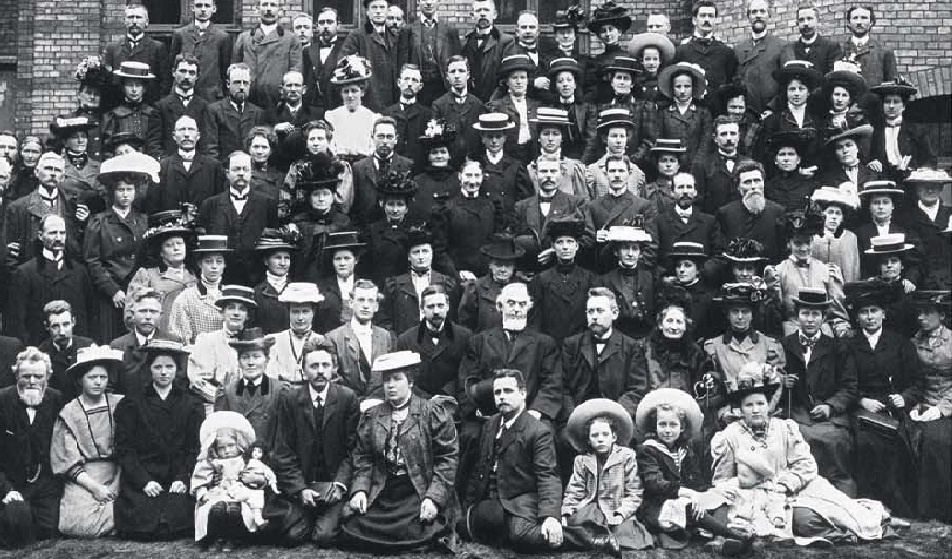 Charles Russell with Bible Students in Copenhagen, Denmark, 1909.
The organizational structure Charles Taze Russell built between 1879 and his death in 1916 was radically different from the top-down theocratic hierarchy Jehovah's Witnesses live under today. Russell's Bible Students practiced congregational democracy: elders were elected by local vote, congregations were autonomous, discipline was handled by the group rather than by judicial committees, and no central authority could dictate belief. Russell explicitly rejected formal organization as "wholly unnecessary" and insisted his movement had "no creed or confession." Understanding how the early movement actually functioned — and how dramatically it was later transformed under Joseph Rutherford — is essential to evaluating the Watchtower's claim of organizational continuity from Russell to the present day.
The Publishing Engine: Zion's Watch Tower Tract Society
The organizational backbone of Russell's movement was not a church — it was a publishing corporation.
On February 16, 1881, Russell formed Zion's Watch Tower Tract Society as a voluntary, unincorporated association in Allegheny, Pennsylvania. William Henry Conley, a Pittsburgh industrialist and philanthropist, served as president, with Russell as secretary-treasurer.[1] The Society's stated purpose was to organize the printing and distribution of religious tracts — not to govern congregations.
On December 15, 1884, the Society was officially incorporated under Pennsylvania law as a non-profit, non-stock corporation, with Russell as president.[2] The charter, written by Russell himself, stated the organization's purpose as "the mental, moral and religious improvement of men and women, by teaching the Bible by means of the publication and distribution of Bibles, books, papers, pamphlets, and other Bible literature, and by providing oral lectures free for the people."[3]
Russell was emphatic about the Society's limited scope. He stated: "Zion's Watch Tower Tract Society is not a 'religious society' in the ordinary meaning of this term. This is a business association merely... It has no creed or confession. It is merely a business convenience in disseminating the truth."[4]
The Voting Share System
The Society operated on a unique voting share system. Anyone subscribing $10 or more to the Society's tracts or donating $10 or more was deemed a voting member, entitled to one vote per $10 donated.[5] In practice, however, this democratic structure gave Russell effective control. As of December 1893, Russell and his wife Maria owned 3,705 of the 6,383 voting shares — 58 percent — giving them a built-in majority over all possible challengers.
Russell was candid about this arrangement: "Thus control the Society; and this was fully understood by the directors from the first. Their usefulness, it was understood, would come to the front in the event of our death... For this reason, also, formal elections were not held; because it would be a mere farce."[6]
After Russell's separation from Maria in 1897, the influx of donations gradually diluted the Russells' proportion. By 1908, their voting shares constituted less than half the total. Russell responded by requiring directors to write out undated resignations upon appointment, so he could dismiss them by simply filling in the date.[7]
The International Bible Students Association
As the movement grew internationally, additional legal entities were created. In 1909, Russell instructed his legal counsel, Joseph F. Rutherford, to investigate moving headquarters to Brooklyn, New York. Rutherford reported that the Pennsylvania corporation could not be registered in New York, and recommended forming a new entity. The People's Pulpit Association was incorporated on February 23, 1909, with a charter — also drafted by Rutherford — that gave the president "absolute power and control" of its activities.[8]
The International Bible Students Association (IBSA) was incorporated in London in 1913 as the movement's British and international arm.[9] Russell explained that the IBSA would be directed by the People's Pulpit Association, which in turn represented the Watch Tower Bible and Tract Society. All Bible Student classes (congregations) using Watch Tower publications could consider themselves identified with the IBSA and were authorized to use its name.[10]
By Russell's death in 1916, three interlocking legal corporations existed: the Watch Tower Bible and Tract Society (Pennsylvania), the People's Pulpit Association (New York), and the International Bible Students Association (London). This structure — a constellation of publishing entities rather than an ecclesiastical hierarchy — reflected Russell's vision of the movement as a voluntary fellowship united by shared study, not a denomination controlled from the top.
Coping with toxic family dynamics, estrangement, and rebuilding your life. For anyone dealing with the fallout of leaving a high-control group.
View on Amazon →Congregational Polity: Democracy Under Russell
Autonomous Congregations
The most striking difference between Russell's movement and the modern Jehovah's Witness organization is the degree of local autonomy congregations enjoyed. Early Bible Student congregations — called "classes" or "ecclesias" — were self-governing bodies with no central authority dictating their affairs.[11]
Russell explicitly rejected the concept of a formal organizational hierarchy as "wholly unnecessary" and declared that his group had no record of its members' names, no creeds, and no sectarian name. He wrote in February 1884: "By whatsoever names men may call us, it matters not to us... we call ourselves simply Christians."[12]
Elected Elders and Deacons
Elders and deacons were elected by congregational vote — a democratic procedure that stands in stark contrast to the modern practice of appointment by the Governing Body through circuit overseers. Each year (or more often if needed), the qualifications of those who might serve were considered and a vote was taken by all "fully consecrated" members of the congregation.[13]
The Watchtower's own Proclaimers book acknowledges this, stating that the early arrangement was "basically a democratic procedure, but one that was hedged about with limitations designed to act as a safeguard."[14] Russell tolerated a "great latitude of belief among members" — a concept unimaginable in the modern organization, where deviation from Governing Body doctrine is grounds for disfellowshipping.[15]
Discipline Without Judicial Committees
Russell's approach to discipline was dramatically more lenient than modern Watchtower practice. He opposed formal disciplinary procedures by congregation elders, claiming this was beyond their authority. Instead of judicial committees and disfellowshipping (which did not exist in their modern form until decades later), Russell recommended that an individual who continued in a wrong course simply be allowed to drift away, with fellowship naturally limited but not formally severed.[16]
Disfellowshipping as practiced by modern Jehovah's Witnesses — with its secret judicial committees, mandatory shunning, and social death for dissenters — was a product of the Rutherford and Knorr eras, not of Russell's movement.
The Colporteur System
Russell's primary method of evangelism was literature distribution through a network of colporteurs — the forerunners of today's "pioneers." In the April 1881 Zion's Watch Tower, Russell ran a striking appeal: "Wanted 1,000 Preachers." He urged anyone who could devote half or more of their time to go forth "into large or small cities, according to your ability, as Colporteurs or Evangelists."[17]
The initial response fell short — by 1885 there were about 300 colporteurs — but the system grew steadily.[18] Colporteurs left householders with copies of Russell's publications and returned days later to retrieve the books or accept payment. They received a commission on sales, but Russell warned them to concentrate less on money than on spreading the message. By the time of his death, there were 372 colporteurs operating in the field.[19]
The colporteur system was supplemented by "pilgrims" — traveling speakers introduced in 1894 who visited congregations for up to three days, giving talks and encouragement. Pilgrims were chosen for their maturity, meekness, and Bible knowledge. Initially part-time, they later became full-time representatives. By the 1910s, Russell's organization maintained nearly a hundred pilgrims.[20]
The Newspaper Sermon Syndicate
One of Russell's most effective publicity vehicles was a newspaper syndicate that published his weekly sermons. When a Pittsburgh newspaper's publication of Russell's 1903 debates with Methodist minister Dr. E. L. Eaton resulted in massive demand for copies, several newspapers began printing Russell's sermons regularly.[21]
By 1907, twenty-one million copies of his sermons were being printed annually in eleven U.S. newspapers. Russell entered a contract with a newspaper syndicate to broaden coverage further. By December 1909, his sermons were appearing in 400 newspapers, and at their peak, more than 2,000 newspapers with a combined circulation of fifteen million readers carried his discourses.[22] No modern Watchtower leader has achieved anything remotely comparable in terms of mass-media penetration.
Overseas Expansion
The Bible Student movement expanded internationally during Russell's lifetime, though on a modest scale:
1881: Bible Student missionaries sent to England.[23]
1900: First overseas branch office opened in London.[24]
1903: Branch opened in Germany.[25]
1904: Branches opened in Australia and Switzerland.[26]
By 1910, approximately 50,000 people worldwide were associated with the movement, and Russell served as annually re-elected pastor of more than 1,200 congregations in various countries.[27]
The Photo-Drama of Creation (1914)
Russell's most ambitious production was the Photo-Drama of Creation, an innovative eight-hour multimedia presentation that combined synchronized sound, moving film, and hand-painted color slides to trace the history of the world from creation through the millennium.[28]
Production began as early as 1912. At least twenty four-part sets were prepared, enabling showings in eighty cities per day. The full production premiered in January 1914 in New York. By the end of that year, over nine million people in North America, Europe, and Australia had viewed the Photo-Drama or its abbreviated version, the Eureka-Drama.[29] The project cost approximately $300,000 — a staggering sum for the era.
The Photo-Drama was genuinely groundbreaking. It was one of the first major productions to combine film with synchronized audio, predating the widespread adoption of "talkies" by over a decade. Whatever one thinks of Russell's theology, the Photo-Drama demonstrated organizational ambition and technical innovation of a high order.
Early Splinter Groups
Even during Russell's lifetime, the movement experienced significant schisms — a fact that complicates the Watchtower's narrative of smooth, divinely guided organizational continuity.
The New Covenant Controversy (1907–1909)
The most significant pre-1916 split arose over the New Covenant doctrine. In 1905, traveling pilgrim Paul S. L. Johnson pointed out that Russell's teaching on the New Covenant had undergone a complete reversal: until 1880, Russell had taught that the New Covenant would only be inaugurated after the last of the 144,000 anointed Christians had been taken to heaven, but since 1881 he had written that it was already in force.[30]
In January 1907, Russell reversed himself again, reaffirming his 1880 position — that the New Covenant "belongs exclusively to the coming age" — and adding the novel teaching that the church had no mediator, only an "advocate" in Christ.[31]
On October 24, 1909, Ernest C. Henninges, the Australian branch manager based in Melbourne and a former Watch Tower Society secretary-treasurer, wrote Russell an open letter protesting this reversal. When Russell refused to reconsider, Henninges and most of the Melbourne congregation left to form the New Covenant Fellowship.[32] Hundreds of the estimated 10,000 U.S. Bible Students also departed, including pilgrim Matthew L. McPhail and A. E. Williamson of Brooklyn, forming the New Covenant Believers (later known as the Berean Bible Students Church).[33]
Other Early Departures
Smaller defections occurred throughout Russell's tenure. His teachings were evolving constantly, and each doctrinal adjustment caused some followers to exit. The congregational autonomy Russell championed gave local groups the freedom to stay or leave as their conscience dictated — a freedom that would be progressively curtailed under Rutherford after 1917.
How Russell's Organization Differed from What Came After
The contrast between Russell's movement and the modern Jehovah's Witness organization cannot be overstated. Understanding these differences is critical for evaluating the Watchtower's claim that it has been God's continuous channel of communication since the 1870s:
| Feature | Under Russell (1879–1916) | Under Modern JW Organization |
|---|---|---|
| Congregational governance | Elders elected by local democratic vote[13] | Elders appointed by circuit overseers under Governing Body direction |
| Congregational autonomy | Each congregation (ecclesia) self-governing and autonomous[12] | All congregations controlled by centralized Governing Body |
| Discipline | No formal judicial committees; wrongdoers allowed to drift away[16] | Secret judicial committees; mandatory shunning of disfellowshipped persons |
| Tolerance of dissent | Great latitude of belief tolerated[15] | Any deviation from Governing Body doctrine is grounds for discipline |
| Nature of the Society | "A business association merely" — a publishing entity[4] | Theocratic organization claiming to be God's sole channel of communication |
| Creeds | "No creed or confession"[4] | Detailed, mandatory doctrinal positions enforced on all members |
| Membership records | No formal record of members' names[12] | Detailed publisher record cards tracked by headquarters |
| Christmas, birthdays, etc. | Celebrated by early Bible Students[34] | Strictly prohibited as "pagan" |
The organization Russell built and the organization that exists today share a name and a legal lineage, but almost nothing else. Rutherford's transformation of the movement after 1917 was so thoroughgoing that multiple Bible Student groups broke away specifically to preserve Russell's original teachings and democratic structure — splinter groups that continue to operate to this day.
Timeline
| Date | Event |
|---|---|
| Jul. 1879 | First issue of Zion's Watch Tower and Herald of Christ's Presence published; 6,000 copies distributed[35] |
| 1879–1880 | Russell visits thirty newly formed congregations to establish meeting format[36] |
| Apr. 1881 | "Wanted 1,000 Preachers" — Russell launches the colporteur system[17] |
| Feb. 16, 1881 | Zion's Watch Tower Tract Society formed as voluntary association[1] |
| Dec. 15, 1884 | Society officially incorporated under Pennsylvania law; Russell elected president[2] |
| 1889 | Headquarters reportedly moves to newly built Bible House at 610–14 Arch Street, Pittsburgh[37] |
| 1894 | Russell introduces the "pilgrim" system of traveling speakers[20] |
| 1895 | Congregations begin paragraph-by-paragraph study of Studies in the Scriptures[38] |
| 1900 | First overseas branch opened in London[24] |
| 1903 | Branch opened in Germany[25] |
| 1904 | Branches opened in Australia and Switzerland[26] |
| 1905 | "Berean Studies" replace verse-by-verse Bible studies[39] |
| 1907–1909 | New Covenant controversy causes first major schism; Henninges and hundreds leave[32] |
| Feb. 1909 | People's Pulpit Association incorporated in New York[8] |
| 1909 | Headquarters moves from Pittsburgh to Brooklyn, New York[40] |
| 1913 | International Bible Students Association incorporated in London[9] |
| Jan. 1914 | Photo-Drama of Creation premieres; eventually seen by over 9 million people[29] |
| 1914 | Approximately 1,200 congregations functioning worldwide[41] |
| Oct. 31, 1916 | Russell dies; the democratic, publishing-centered movement he built begins its transformation under Rutherford[42] |
See Also
- Charles Taze Russell (1852–1916) — Russell's life, teachings, and controversies
- Joseph Franklin 'Judge' Rutherford (1869–1942) — The man who transformed Russell's democratic movement into a top-down theocracy
- Bible Student Splinter Groups — Groups that broke away to preserve Russell's original teachings
- The Governing Body — Structure, History & Power — How central authority evolved from Russell's loose federation to today's Governing Body
- Disfellowshipping & Shunning — Complete History — How discipline went from Russell's lenient approach to mandatory shunning
- Information Control & Thought Reform — How the organization moved from "great latitude of belief" to total doctrinal control
References
1. ↩ "Watch Tower Bible and Tract Society of Pennsylvania," Wikipedia. [en.wikipedia.org]
2. ↩ "Watch Tower Bible and Tract Society of Pennsylvania — Incorporation," Wikipedia. [en.wikipedia.org]
3. ↩ Charter of Zion's Watch Tower Tract Society, December 15, 1884; cited in "Watch Tower Bible and Tract Society of Pennsylvania," Wikipedia. [en.wikipedia.org]
4. ↩ C. T. Russell, cited in "Watch Tower Bible and Tract Society of Pennsylvania," Wikipedia: the Society is "merely a business convenience in disseminating the truth." [en.wikipedia.org]
5. ↩ "Watch Tower Bible and Tract Society of Pennsylvania — Voting shares," Wikipedia. [en.wikipedia.org]
6. ↩ C. T. Russell, cited in "Watch Tower Bible and Tract Society of Pennsylvania," Wikipedia: Russell and his wife owned 58% of voting shares as of December 1893. [en.wikipedia.org]
7. ↩ "Watch Tower Bible and Tract Society of Pennsylvania," Wikipedia: from 1908, Russell required directors to write out undated resignations. [en.wikipedia.org]
8. ↩ "Watch Tower Bible and Tract Society of Pennsylvania — People's Pulpit Association," Wikipedia. [en.wikipedia.org]
9. ↩ "Bible Student movement — International Bible Students Association," Wikipedia. [en.wikipedia.org]
10. ↩ "Bible Student movement," Wikipedia: Russell explained the IBSA would be directed by the People's Pulpit Association. [en.wikipedia.org]
11. ↩ "Part 2 — Small Beginnings (1879–1889)," Watchtower ONLINE LIBRARY (1955 Yearbook). [wol.jw.org]
12. ↩ "Bible Student movement," Wikipedia: Russell rejected formal organization as "wholly unnecessary" and declared the group had no record of members' names or creeds. [en.wikipedia.org]
13. ↩ "Development of the Organization Structure," Watchtower ONLINE LIBRARY. [wol.jw.org]
14. ↩ Jehovah's Witnesses — Proclaimers of God's Kingdom (Watch Tower Bible and Tract Society, 1993), chapter on organizational development. [wol.jw.org]
15. ↩ "Bible Student movement," Wikipedia: Russell tolerated "a great latitude of belief among members." [en.wikipedia.org]
16. ↩ "Bible Student movement," Wikipedia: Russell opposed formal disciplinary procedures by congregation elders. [en.wikipedia.org]
17. ↩ "Wanted 1,000 Preachers," Zion's Watch Tower, April 1881; cited in "Part 2 — Small Beginnings," Watchtower ONLINE LIBRARY. [wol.jw.org]
18. ↩ "Part 1 — United States of America," Watchtower ONLINE LIBRARY (1975 Yearbook). [wol.jw.org]
19. ↩ "A Time of Testing (1914–1918)," Watchtower ONLINE LIBRARY: colporteurs numbered 372 at Russell's death, increased to 461 under Rutherford. [wol.jw.org]
20. ↩ "History of Jehovah's Witnesses," Wikipedia: pilgrim workers introduced in 1894; nearly a hundred by the 1910s. [en.wikipedia.org]
21. ↩ "History of Jehovah's Witnesses," Wikipedia: Pittsburgh newspaper's publication of Russell's 1903 debates led to syndication. [en.wikipedia.org]
22. ↩ "History of Jehovah's Witnesses," Wikipedia: by December 1909, sermons appeared in 400 papers; at peak, 2,000+ newspapers with 15 million readers. [en.wikipedia.org]
23. ↩ "History of Jehovah's Witnesses," Wikipedia: missionaries sent to England in 1881. [en.wikipedia.org]
24. ↩ "Bible Student movement," Wikipedia: London branch opened in 1900. [en.wikipedia.org]
25. ↩ "Bible Student movement," Wikipedia: Germany branch opened in 1903. [en.wikipedia.org]
26. ↩ "Bible Student movement," Wikipedia: Australia and Switzerland branches opened in 1904. [en.wikipedia.org]
27. ↩ "Jehovah's Witnesses," Wikipedia: by 1910, about 50,000 associated worldwide. [en.wikipedia.org]
28. ↩ "Charles Taze Russell — Photo-Drama of Creation," Wikipedia. [en.wikipedia.org]
29. ↩ Jehovah's Witnesses — Proclaimers of God's Kingdom (1993): over 9 million viewers by end of 1914. [wol.jw.org]
30. ↩ "Bible Student movement — New Covenant controversy," Wikipedia. [en.wikipedia.org]
31. ↩ "Bible Student movement," Wikipedia: in January 1907, Russell reaffirmed his 1880 position on the New Covenant. [en.wikipedia.org]
32. ↩ "Bible Student movement," Wikipedia: Henninges' October 1909 open letter and departure. [en.wikipedia.org]
33. ↩ "Bible Student movement," Wikipedia: McPhail and Williamson form New Covenant Believers. [en.wikipedia.org]
34. ↩ Zion's Watch Tower, December 1, 1904, p. 364: Christmas celebration at Bethel acknowledged. See also M. James Penton, Apocalypse Delayed, 3rd ed. (2015).
35. ↩ "Part 2 — Small Beginnings (1879–1889)," Watchtower ONLINE LIBRARY. [wol.jw.org]
36. ↩ "Jehovah's Witnesses," Wikipedia: Russell visited thirty congregations in 1879–1880. [en.wikipedia.org]
37. ↩ "The Watch Tower Society Was Incorporated in 1884," pastorrussell.blogspot.com. [pastorrussell.blogspot.com]
38. ↩ "Bible Student movement," Wikipedia: from 1895, Russell encouraged paragraph-by-paragraph study of Studies in the Scriptures. [en.wikipedia.org]
39. ↩ "Bible Student movement," Wikipedia: in 1905, Russell recommended replacing verse-by-verse studies with "Berean Studies." [en.wikipedia.org]
40. ↩ "Watch Tower Bible and Tract Society of Pennsylvania," Wikipedia: headquarters moved to Brooklyn in 1909. [en.wikipedia.org]
41. ↩ "Part 1 — United States of America," Watchtower ONLINE LIBRARY (1975 Yearbook): 1,200 congregations by 1914. [wol.jw.org]
42. ↩ "Charles Taze Russell," Wikipedia: died October 31, 1916. [en.wikipedia.org]