Information Control & Thought Reform
 Watchtower sign, Brooklyn. Via Wikimedia Commons.
The Watchtower organization does not merely teach doctrines — it controls the information environment in which those doctrines are evaluated. Members are told what to read, what not to read, whom to associate with, what constitutes acceptable thinking, and what questions are too dangerous to ask. Former members' writings are compared to pornography, poison, and gangrene. Independent Bible study — studying the Bible without Watchtower publications — is explicitly warned against as a path to apostasy. Higher education is persistently discouraged. The organization's own embarrassing history is systematically scrubbed from its publications and digital libraries. And the entire system is held in place by a specialized vocabulary — "the truth," "the world," "new light," "apostate" — that programs members to experience doubt itself as a spiritual threat. These are not incidental features of the organization. They constitute a system of control — mechanisms by which the Governing Body maintains its authority over millions of people.
The Ban on "Apostate" Material
The most explicit information control mechanism is the blanket prohibition on reading, watching, or listening to anything produced by former Jehovah's Witnesses or critics of the organization. The Watchtower has used visceral language to describe such material:
Compared to pornography: "Suppose that a doctor told you to avoid a certain food because it is contaminated. Would you just take a small amount of that food, reasoning that a tiny bit would not hurt you? Of course not! ... Well, then, let us also choose to throw away any apostasy-contaminated food."[1]
Compared to poison: A 1986 Watchtower warned: "What will you do if you receive a letter or some literature, open it, and see right away that it is from an apostate? Will curiosity cause you to read it, just to see what he has to say? You may even reason: 'It won't affect me; I'm too strong in the truth.' ... In thinking this way, some have fed their minds upon apostate reasoning and have fallen prey to serious questioning and doubt."[2]
Compared to gangrene: The July 15, 2011 Watchtower described apostates as "mentally diseased" — language so extreme that it prompted complaints in the United Kingdom — and compared their influence to gangrene that might require "amputation" (disfellowshipping) of the infected member.[3]
Steven Hassan, in Combating Cult Mind Control, describes how such warnings create a phobia response to outside information — a conditioned fear reaction that prevents engagement before it begins.[4]
The Prohibition on Independent Bible Study
A religion that claims the Bible is its sole authority might be expected to encourage members to study the Bible independently. The Watchtower does the opposite. It explicitly teaches that the Bible cannot be properly understood without Watchtower publications as an interpretive guide:
"We all need help to understand the Bible, and we cannot find the scriptural guidance we need outside the 'faithful and discreet slave' organization."[5]
"They say that it is sufficient to read the Bible exclusively, either alone or in small groups at home. But, strangely, through such 'Bible reading,' they have reverted right back to the apostate doctrines that commentaries by Christendom's clergy were teaching 100 years ago."[6]
Charles Taze Russell made the point even more explicitly in 1910: "If the 6 volumes of 'Scripture Studies' are practically the Bible topically arranged... not only do we find that people cannot see the divine plan in studying the Bible itself, but we see also that if anyone lays the 'Scripture Studies' aside... after he has read them for 10 years — if he then lays them aside and ignores them and goes to the Bible alone... within 2 years he goes into darkness."[7]
The May 2019 Watchtower instructed members to "Improve Your Study Habits" by doing research — but specified: "Then using our publications, do careful research." Any secular researcher would recognize that consulting only one source is the antithesis of genuine research. But for Jehovah's Witnesses, the organization's publications are presented as sufficient — and outside sources are presented as dangerous.[8]
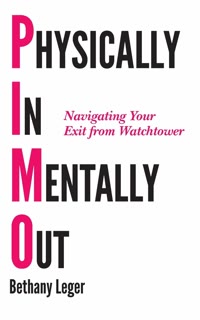
If you're navigating life as a PIMO or planning your exit, this book was written for you. Practical, compassionate guidance for every stage of waking up.
View on Amazon →Higher Education: Persistently Discouraged
The Watchtower has discouraged higher education for decades, using the urgency of Armageddon, the spiritual danger of university environments, and the priorities of full-time ministry as justifications:
1969: "Many schools now have student counselors who encourage one to pursue higher education after high school, to pursue a career with a future in this system of things. Do not be influenced by them. Do not let them 'brainwash' you with the Devil's propaganda to get ahead, to make something of yourself in this world."[9]
2005: According to accounts widely circulated in the ExJW community, Governing Body member Anthony Morris III delivered a talk describing university as spiritually deadly, comparing young Witnesses attending college to soldiers entering a minefield.[10]
Ongoing: While the organization has softened its explicit anti-education language in some publications, the persistent message from convention platforms, Kingdom Hall talks, and organizational culture remains that full-time pioneering is superior to higher education, and that the "best life ever" does not require a degree.
The practical effect: generations of Witnesses have entered adulthood without the education needed for economic self-sufficiency. When they leave or are disfellowshipped — losing their entire social network — they face the additional burden of having been systematically denied the credentials that would have enabled them to support themselves independently.
Internet Warnings
The rise of the internet posed an existential threat to the Watchtower's information control. Before the internet, critical information about the organization was scattered across out-of-print books, obscure newsletters, and word of mouth. After the internet, everything was a search query away.
The organization responded with increasingly urgent warnings. A 1997 Our Kingdom Ministry stated: "Connecting a computer to an electronic bulletin board can open the way to serious spiritual dangers. Just as an unscrupulous individual can place on a bulletin board a virus... apostates, clergymen, and persons seeking to corrupt others morally or otherwise can freely place their poisonous ideas on bulletin boards."[11]
Subsequent warnings discouraged Witnesses from engaging in online discussions about their faith, visiting websites critical of the organization, or even using search engines to research questions about Watchtower history or doctrine. The organization launched its own website (jw.org) in 1997 and JW Broadcasting in 2014, creating an approved digital ecosystem designed to keep members within the information boundaries set by the Governing Body.[12]
Library Purges and Revised History
According to documentation compiled by independent ExJW researchers and forum compilations, the Watchtower has reportedly removed a number of embarrassing publications from its digital archives. Key documents reported to have been excluded from the Watchtower Library CD-ROM or jw.org include:
- The 1966 Life Everlasting in Freedom of the Sons of God — the book that launched the 1975 prediction
- Key 1968 Awake! articles tying 1975 to the "end of 6,000 years"
- The May 1974 Kingdom Ministry praising members who sold homes
- The 1967 Watchtower declaring organ transplants "cannibalism"
- Older publications containing pyramidology, Russell-era chronology, and abandoned doctrines[13]
The Loaded Language System
Robert Jay Lifton, in his landmark study Thought Reform and the Psychology of Totalism (1961), identified "loaded language" as a key mechanism of thought reform: specialized vocabulary that compresses complex ideas into simple, emotionally charged terms that short-circuit critical thinking. The Watchtower's vocabulary is a textbook example:
| Term | Watchtower Usage | Function |
|---|---|---|
| "The Truth" | Refers to Watchtower doctrine and the organization itself | Equates the organization's teachings with objective reality; to leave "the truth" is to leave truth itself |
| "The World" | Everything and everyone outside the organization | Creates a binary: you are either in the organization or in "the world" (which is ruled by Satan) |
| "Worldly" | Non-Witnesses; their attitudes, activities, values | Stigmatizes all outside influences as contaminated and spiritually dangerous |
| "New Light" | Any doctrinal change, no matter how contradictory | Reframes errors as progressive revelation; prevents accountability for false teaching |
| "Apostate" | Any former member who speaks critically of the organization | Creates a phobia; the word triggers fear and disgust, preventing engagement with the person's actual arguments |
| "Independent thinking" | Reaching conclusions that differ from Watchtower teaching | Pathologizes critical thought; frames it as a character defect inspired by Satan |
| "Spiritually weak" | Members who question, miss meetings, or reduce field service | Weaponizes social pressure; doubts become evidence of personal moral failure |
| "Encouraged" | A directive that is functionally mandatory | Allows the organization to deny coercion while enforcing compliance through social pressure |
This vocabulary is used so pervasively that Witnesses often do not realize they are speaking in a specialized code. When a Witness says "I'm in the truth," they mean "I am a Jehovah's Witness." When they describe someone as "worldly," they mean "not a Jehovah's Witness." Robert Jay Lifton identified this type of language system as creating a framework in which the organization is always right, the outside world is always dangerous, and doubt is always a personal spiritual failure rather than an appropriate response to problematic evidence.[15]
Fear, Guilt, and Conditional Love
Armageddon as Control
The ever-present threat of Armageddon — the imminent destruction of everyone who is not an active, obedient Jehovah's Witness — functions as the organization's ultimate enforcement tool. It is not presented as a distant theological abstraction but as an event that could happen tomorrow. Children are taught from infancy that their non-Witness schoolmates will be destroyed by God. Convention videos depict graphic destruction scenes. The message is clear: stay obedient or die.[16]
Love-Bombing and Conditional Love
New members and potential converts experience "love-bombing" — an intense outpouring of warmth, attention, and inclusion that creates a powerful emotional bond. But this love is conditional: it exists only as long as the member remains active, compliant, and uncritical. The moment a person begins to question, miss meetings, or express doubt, the warmth is systematically withdrawn — first through subtle social distancing ("marking"), then through formal shunning if necessary.[17]
The Confession/Surveillance Culture
Witnesses are encouraged to confess "serious sins" to elders — and to report the sins of fellow Witnesses. This creates an environment of mutual surveillance where members police each other's behavior and thoughts. The knowledge that any friend or family member might report a private conversation to the elders produces pervasive self-censorship. Members learn to monitor not just their actions but their thoughts — since even private disagreement with doctrine, if discovered, can lead to a judicial committee.[18]
The BITE Model Applied
Cult expert Steven Hassan, a former member of the Unification Church, developed the BITE model as a framework for identifying high-control groups. BITE stands for Behavior control, Information control, Thought control, and Emotional control. Hassan and former Witness Kimmy O'Donnell published a detailed application of the model to Jehovah's Witnesses, finding that the organization meets virtually every criterion:[19]
| BITE Category | Watchtower Application |
|---|---|
| Behavior Control | Strict meeting attendance requirements; field service reporting; dress/grooming codes; restrictions on association with non-Witnesses; sexual conduct regulated in detail; beards prohibited until 2023; members expected to seek elder approval for major decisions |
| Information Control | Apostate material forbidden; independent research discouraged; Watchtower publications presented as sole reliable source; internet warnings; library purges of embarrassing history; revised organizational narratives |
| Thought Control | "Independent thinking" vilified; loaded language ("the truth," "apostate," "worldly"); black-and-white thinking (organization = good, world = evil); doctrine internalized as absolute truth; questioning equated with disloyalty to God |
| Emotional Control | Fear of Armageddon; fear of shunning; guilt over not doing enough (field service, meeting attendance, donations); love-bombing followed by conditional withdrawal of affection; phobia indoctrination against leaving |
It should be noted that Hassan's BITE model has drawn criticism from some scholars who argue it is too broadly applicable and lacks rigorous empirical validation. However, the specific behaviors documented in Watchtower publications — the ban on outside reading, the prohibition of independent thinking, the weaponization of fear, and the use of shunning to enforce compliance — are not matters of subjective interpretation. They are documented in the organization's own literature.[21]
How the Information Age Is Undermining Control
Despite the Watchtower's efforts, the internet has fundamentally eroded its ability to control information. Websites like JWfacts.com, AvoidJW.org, and the ExJW subreddit (r/exjw, with over 100,000 members) provide comprehensive documentation of the organization's history, doctrinal changes, and harmful practices — all sourced directly from Watchtower publications.
YouTube channels run by former Witnesses reach audiences in the hundreds of thousands. The Australian Royal Commission testimony is publicly available. Raymond Franz's Crisis of Conscience can be read online. Every doctrinal change, every failed prediction, every contradictory statement is now searchable, shareable, and permanent.
The organization's response has been to accelerate its own media production — JW Broadcasting, jw.org, a dedicated app — creating an approved digital environment. But the very existence of the internet means that any Witness with a smartphone and a moment of doubt has access to more documented organizational history than the Governing Body has ever voluntarily disclosed. The information asymmetry that had sustained the organization for over a century has been significantly disrupted.[22]
See Also
- Disfellowshipping & Shunning — Complete History — The enforcement mechanism behind information control
- The Two-Witness Rule — The evidentiary standard that protects the institution
- The 'Faithful and Discreet Slave' — Shifting Identity — The doctrinal basis for claiming sole authority over information
- The Governing Body — Structure, History & Power — The body that controls what Witnesses may read and think
- The ExJW Movement — Key Figures & Resources — The community that the internet made possible
- Major Doctrinal Reversals — Complete Registry — The history the organization tries to suppress
References
1. ↩ The Watchtower, July 15, 2011: apostate material compared to contaminated food. [jwfacts.com]
2. ↩ The Watchtower, March 15, 1986, p. 12. [bible.ca]
3. ↩ The Watchtower, July 15, 2011: apostates described as "mentally diseased"; influence compared to gangrene. [reachouttrust.org]
4. ↩ Steven Hassan, Combating Cult Mind Control (25th anniversary ed., 2015): describes phobia indoctrination and conditioned fear responses to outside information. [freedomofmind.com]
5. ↩ The Watchtower, February 15, 1981, p. 19. [bible.ca]
6. ↩ The Watchtower, August 15, 1981, p. 29. [bible.ca]
7. ↩ C.T. Russell, The Watchtower, September 15, 1910, p. 298. [bible.ca]
8. ↩ The Watchtower, May 2019, "Improve Your Study Habits": "Then using our publications, do careful research." [reachouttrust.org]
9. ↩ The Watchtower, March 15, 1969, p. 171. [jwfacts.com]
10. ↩ Anthony Morris III, convention talk comparing university to a spiritual minefield; widely cited in ExJW community.
11. ↩ Our Kingdom Ministry, 1997: internet compared to spiritual virus. [bible.ca]
12. ↩ JW.org launched 1997; JW Broadcasting launched October 2014. [reachouttrust.org]
13. ↩ "PDF documentation regarding 1975 prediction in WT publications," jehovahs-witness.com: key publications excluded from Watchtower Library CD-ROM. [jehovahs-witness.com]
14. ↩ Jehovah's Witnesses — Proclaimers of God's Kingdom (1993): the organization's official history, criticized for selective presentation and omissions. [jwfacts.com]
15. ↩ Robert Jay Lifton, Thought Reform and the Psychology of Totalism (1961): identified "loaded language" as a key mechanism of thought reform. Applied to JW vocabulary by multiple analysts. [reachouttrust.org]
16. ↩ "The BITE Model and Jehovah's Witnesses," Freedom of Mind Resource Center: fear of Armageddon and shunning keeps members dedicated. [freedomofmind.com]
17. ↩ Steven Hassan, Combating Cult Mind Control: love-bombing and conditional love as recruitment and retention tools.
18. ↩ "Steve Hassan's BITE model mapped to WTS," jehovahs-witness.com: JWs expected to confess sins to elders; self-policing and reporting encouraged. [jehovahs-witness.com]
19. ↩ Steven Hassan and Kimmy O'Donnell, "The BITE Model and Jehovah's Witnesses," Freedom of Mind Resource Center. [freedomofmind.com]
20. ↩ "The BITE Model and Jehovah's Witnesses," Freedom of Mind Resource Center: detailed mapping of BITE criteria to Watchtower practices. [freedomofmind.com]
21. ↩ "The Truth, Please, About Steven Hassan: The BITE Model as Pseudoscience," Bitter Winter (2026): criticism of the BITE model's empirical basis. [bitterwinter.org]
22. ↩ "The real reasons why Watchtower organization fears the Internet," bible.ca. [bible.ca]